HERLUIN, LORD OF HAUGHTON-ON-THE-HILL
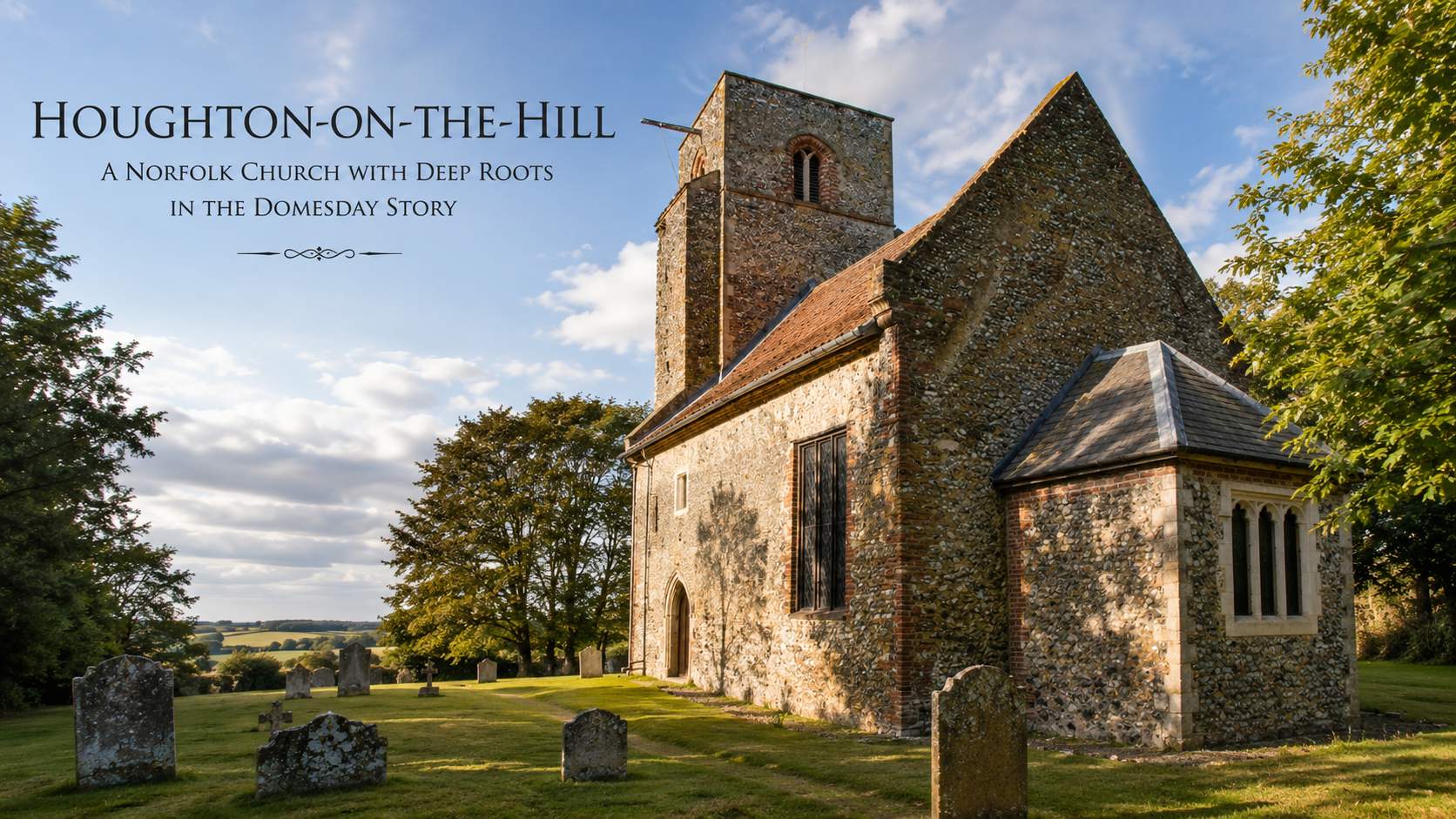
Houghton-on-the-Hill and the Mystery of Herluin
From Houghton to Haughton: A Missing Chapter in the le Strange Story
The story begins in Norfolk in 1086.
At Houghton-on-the-Hill, the Domesday survey records two men with particularly interesting names: Reginald fitz Ivo and Herluin fitz Ivo. The shared patronymic suggests that both were sons of a man named Ivo, and possibly brothers.
Herluin is especially intriguing because another Norfolk landholder appears in Domesday under the name Ralph fitz Herluin — Ralph, son of Herluin. It is this man who is the ancestor of the le Stranges holding land under the same wealthy overlord Reginald fitz Ivo as Herluin of Houghton.
Not least, Herluin fitz Ivo is associated with seven Norfolk places in Domesday, representing six Domesday entries. Remarkably, all fall within the fee of Reginald fitz Ivo, who appears as tenant-in-chief above him at all of his land holdings.
Herluin's lands were: Ashill, Fincham, Haveringland, Houghton-on-the-Hill, North & South Pickenham, Panworth, Thurton.
Interestingly, at Haveringland there is a Ralph and Herluin fitz Ivo - possible father & son, whose same overlord is Reginald fitz Ivo. This beckons the question as to whether Reginald was the uncle of Ralph son of Herluin of Hunstanton.
This linked network raises a tantalising possibility:
Ivo → Herluin fitz Ivo → Ralph fitz Herluin
If Herluin of Houghton was indeed Ralph's father, this would take the ancestry associated with the later le Strange family back another generation. It is not yet a proven relationship, but the possibility becomes more interesting when we follow what happened to Houghton itself.
The trail disappears
After Domesday, Herluin vanishes from the story.
Houghton did not remain with his family. It passed into the great northern estates associated with Ribald, lord of Middleham and brother of Alan Rufus. It is around this era that the lavish paintings inside St. Mary's Church at Houghton on the Hill date back to around the 1190's were likely to have been commissioned by Ribald, but as Herluin fitz Ivo, was the wealthy Lord of Haughton on the HIll we cannot rule out the possibility of either of the men commissioning the wall paintings.
From this point the documentary trail becomes frustratingly quiet.
For roughly the next seventy years, we cannot follow Herluin's family with any certainty.
But seventy years in the twelfth century is not an enormous genealogical gulf. It represents perhaps only two or three generations — and most importantly those generations lived through a period in which families moved, acquired new estates and increasingly exchanged patronymics such as fitz Ivo and fitz Herluin for names derived from the places where they lived.
And when the story becomes visible again, it does so somewhere rather interesting.
Not in Norfolk, but in Shropshire.
Haughton, Haughmond and the FitzAlans
Just outside Shrewsbury stood Haughmond Abbey, the great religious house closely associated with the FitzAlan lords of Shropshire.
Nearby was a place called Haughton.
The medieval records preserve both the place and people described as de Hauston — “of Haughton”. By the middle decades of the twelfth century, the Haughtons belonged to the same broad FitzAlan world into which the le Strange brothers were also emerging.
This is where the geography begins to tighten.
The FitzAlans were among the greatest lords in Shropshire. Their influence stretched across a network of estates, knights and dependent manors, while Haughmond Abbey stood at the spiritual centre of their patronage.
Among those who entered this circle was Hamo le Strange.
And Hamo's relationship with the Haughtons was not merely geographical.
It involved the land upon which the future le Strange lordship of Knockin would be built.
Before Knockin, there was Osbaston
Before Knockin became synonymous with the le Strange family, the territory formed part of the manor of Osbaston.
Osbaston belonged to the FitzAlan lordship, but the FitzAlans had granted it to the Haughton family.
Then, around the beginning of Henry II's reign in 1154–55, the Haughtons transferred their interest in Osbaston to Hamo le Strange.
It is a small transaction on paper, but an enormously important one in the history of the family.
Hamo was effectively stepping into the Haughtons' place.
The land remained within the FitzAlan feudal world, but the lord occupying Osbaston had changed.
The Haughtons were followed by a le Strange.
And Osbaston included the territory which would shortly become Knockin.
Hamo and Haughmond Abbey
Hamo's appearance in this landscape was no isolated event.
He had taken over the Haughtons' holding at Osbaston, held land within the FitzAlan barony, and he was already giving property to the FitzAlans' favoured Haughmond Abbey.
The foundations of the later le Strange power in Shropshire were beginning to appear.
But why Hamo?
This is perhaps the most interesting question.
Why did the Haughtons transfer Osbaston specifically to Hamo le Strange?
There may have been nothing mysterious about it.
Hamo was clearly trusted within the same FitzAlan circle and was establishing himself as an important landholder in Shropshire. The transfer may simply have reflected the political reshuffling which followed Henry II's accession.
But there is another reason the transaction catches the eye.
Nearly seventy years earlier, back in Norfolk, we began with Herluin fitz Ivo at Houghton-on-the-Hill.
If that Herluin was the father of Ralph fitz Herluin, then he potentially belongs immediately behind the Norfolk ancestry from which the le Strange story emerges.
Then the trail disappears.
When we pick it up again, Hamo le Strange is in Shropshire — and the estate that will become the family's great seat passes to him from a family called Haughton.
There is also Haughton Manor itself, lying in the landscape of Haughmond Abbey and the FitzAlans.
The similarity is impossible not to notice.
But it is also important not to make it prove more than it does.
Houghton and Haughton
Houghton and Haughton are variants of a very common English place-name. Their similarity cannot demonstrate that the Haughtons of Shropshire descended from Norfolk or Herluin’s family once associated with Houghton-on-the-Hill in Norfolk.
Nor has a document yet emerged linking Herluin directly to the Shropshire Haughtons.
What we have instead is something more intriguing: a missing chapter.
In 1086, Herluin fitz Ivo is at Houghton-on-the-Hill.
Soon afterwards Houghton passes into the estates associated with Ribald, and Herluin disappears from view.
For the next two or three generations, the trail is uncertain.
Around 1154-55, Hamo le Strange enters Osbaston in Shropshire in succession to the Haughtons.
At the same time he is closely involved with William fitz Alan [I] and Haughmond Abbey.
And the land he has acquired from the Haughtons contains a place that is about to become extraordinarily important.
Knockin.
Hamo died before Michaelmas 1160 without a legitimate heir of his own. Although there is a witness to a Haughton Deed so named Robert son of Hamo there is no evidence that he is the son of Hamo le Strange.
And so the story that begins with a man named Herluin at Houghton in 1086 eventually brings us, seventy years later, to Hamo le Strange taking over the Haughtons' estate at Osbaston.
Whether this is just a fun riddle or those two ends of the story are tied by blood remains a mystery!