Matilda of Hunstanton: The Forgotten Heiress Behind the le Strange Family
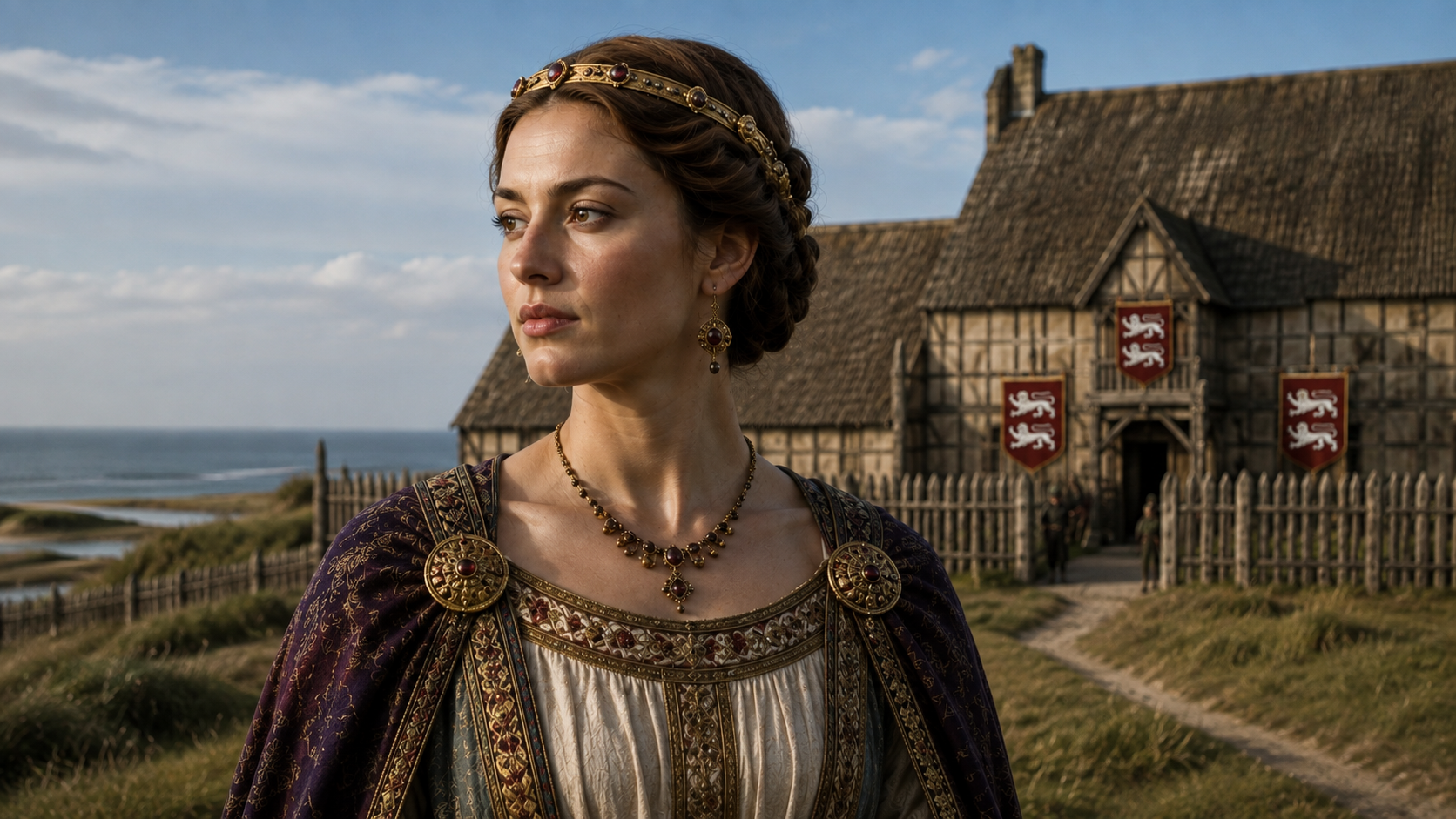
Matilda of Hunstanton: An East Anglian Heiress
Matilda, later the wife of Roland le Strange, was born into a landed Anglo-Norman family whose estates connected the coast of north-west Norfolk with the country around Thetford and Barnham in Suffolk.
She was the daughter of Ralph fitz Herluin, the Domesday lord associated with Hunstanton, and his wife Helewise, daughter of Hugh fitz Golda, the Domesday landholder later remembered as Hugh de Plaiz.
A Clue to Matilda’s Appearance?
Matilda had two brothers, and there is an intriguing little detail hidden in the family names. Both Matilda and her brother Reginald were known by the additional name “le Brun” — at a time when hereditary surnames were only beginning to become established.
Le Brun literally means “the brown” and was commonly used as a descriptive byname, potentially referring to a person's brown or dark colouring — perhaps their hair, complexion, or general appearance.
It gives us a tantalising, if imperfect, glimpse of what Matilda may have looked like.
As a woman born into the new Anglo-Norman landed nobility, we have therefore chosen to depict Matilda with rich brown hair, dressed as a noblewoman of the early twelfth century.
We cannot, of course, know her exact appearance after nine centuries. But le Brun gives us something unusually personal to work with: a tiny clue preserved in her name.
Growing Up Between Two Family Inheritances
We do not know where Matilda was born or where she spent her childhood. It would therefore be unsafe to describe her simply as having “grown up at Hunstanton.”
Her family possessed interests in more than one place, and noble households of this period were not necessarily permanently based at a single residence.
The landscape of her family can still be reconstructed.
At Barnham there was already a settled agricultural community, with cultivated land, livestock and a church. St Martin's stood within this medieval landscape. Nearby Thetford was one of the important towns of East Anglia.
Hunstanton offered a very different environment: a wealthy coastal estate in north-west Norfolk.
Hunstanton must have formed an important part of Matilda's family world. Her father Ralph fitz Herluin held substantial lands there at the time of Domesday in 1086, under Roger Bigod. Matilda would eventually become heiress to this Hunstanton inheritance.
Her mother's background brought another geographical dimension.
Helewise was a daughter of Hugh fitz Golda, an important tenant of William de Warenne whose estates were spread across several counties. Hugh's holdings included land at Barnham in Suffolk, close to Thetford.
A later legal case preserves a particularly valuable memory of the family's property arrangements. It records that Hugh gave land at Barnham with his daughter Helewise when she married Ralph fitz Herluin.
Barnham was therefore already part of Matilda's maternal inheritance story before Matilda herself married.
What Would Matilda Have Known?
Matilda was consequently raised within a family whose connections extended considerably beyond one Norfolk manor.
To the north lay Hunstanton, with its productive coastal estate.
To the south lay Barnham, close to Thetford, inherited through her mother's family.
Between them stretched western Norfolk: a landscape of estates, churches, religious houses and aristocratic households connected by lordship, marriage and service.
We cannot know how frequently Matilda travelled between these places. She may have spent much of her childhood at Hunstanton; she may have stayed at Barnham; and she may have spent periods within the households of relatives or other noble families, as was common among the landed classes.
What we can say is that she belonged to a much wider East Anglian aristocratic network.
Matilda and Roland le Strange
This helps to place her marriage to Roland le Strange in context.
Roland was not necessarily a complete stranger arriving unexpectedly at Hunstanton. He appears within the same wider Anglo-Norman world operating in Norfolk during the early twelfth century, with connections to the circle of Alan fitz Flaald.
The marriage therefore united two people whose social worlds could already have overlapped.
For Roland, marriage to Matilda brought him into a substantial established landed family.
For Matilda, Roland brought connections of his own to an increasingly important network of Anglo-Norman and Breton lords.
Their marriage was consequently more than a personal union. It joined land, lordship, inheritance and aristocratic connections.
What Did Matilda Bring to the Marriage?
This requires some care.
Barnham had originally entered Matilda's immediate family through her mother's marriage settlement: Hugh fitz Golda gave Barnham land with Helewise when she married Ralph fitz Herluin.
Matilda subsequently stood within the inheritance of both her parents.
Her brothers Simon and Reginald initially stood ahead of her in the succession. Both, however, died without surviving heirs. Matilda's son John le Strange I ultimately emerged as heir to the family property.
This is why Matilda became so important to the le Strange story.
Through her came the family's claim to Hunstanton, while the Barnham inheritance can also be traced through her maternal family. A dispute in 1194 concerning Barnham explicitly reconstructed the descent from Hugh, through Helewise and Ralph fitz Herluin, their son Reginald, and ultimately into the le Strange family.
So rather than imagining Matilda arriving at her wedding carrying a simple “dowry” consisting of two named manors, it is more accurate to see her as an eventual heiress to a network of inherited property rights.
A Marriage That Changed the Family's Direction
Matilda and Roland's marriage created the family from which the later le Stranges descended.
At first, their world remained distinctly East Anglian. Hunstanton, Barnham, Thetford and the estates of western Norfolk formed the geographical background to the family's earliest generations.
But their sons belonged to a generation whose opportunities would take them much farther west.
Within a few decades, John, Hamo and Guy le Strange became associated with lands and royal service in Shropshire. Their descendants would establish themselves on the Welsh March and become associated with places such as Ness, Cheswardine and eventually Knockin.
Yet behind that later Marcher story stood Matilda.
Her inheritance rooted the first le Strange generation in England and connected Roland and their children to an already established network of East Anglian land, lordship and family relationships.
Before the le Stranges became Marcher lords, their English story belonged to Matilda's landscape.