What’s in a Name? The Breton Clues Behind the First le Stranges
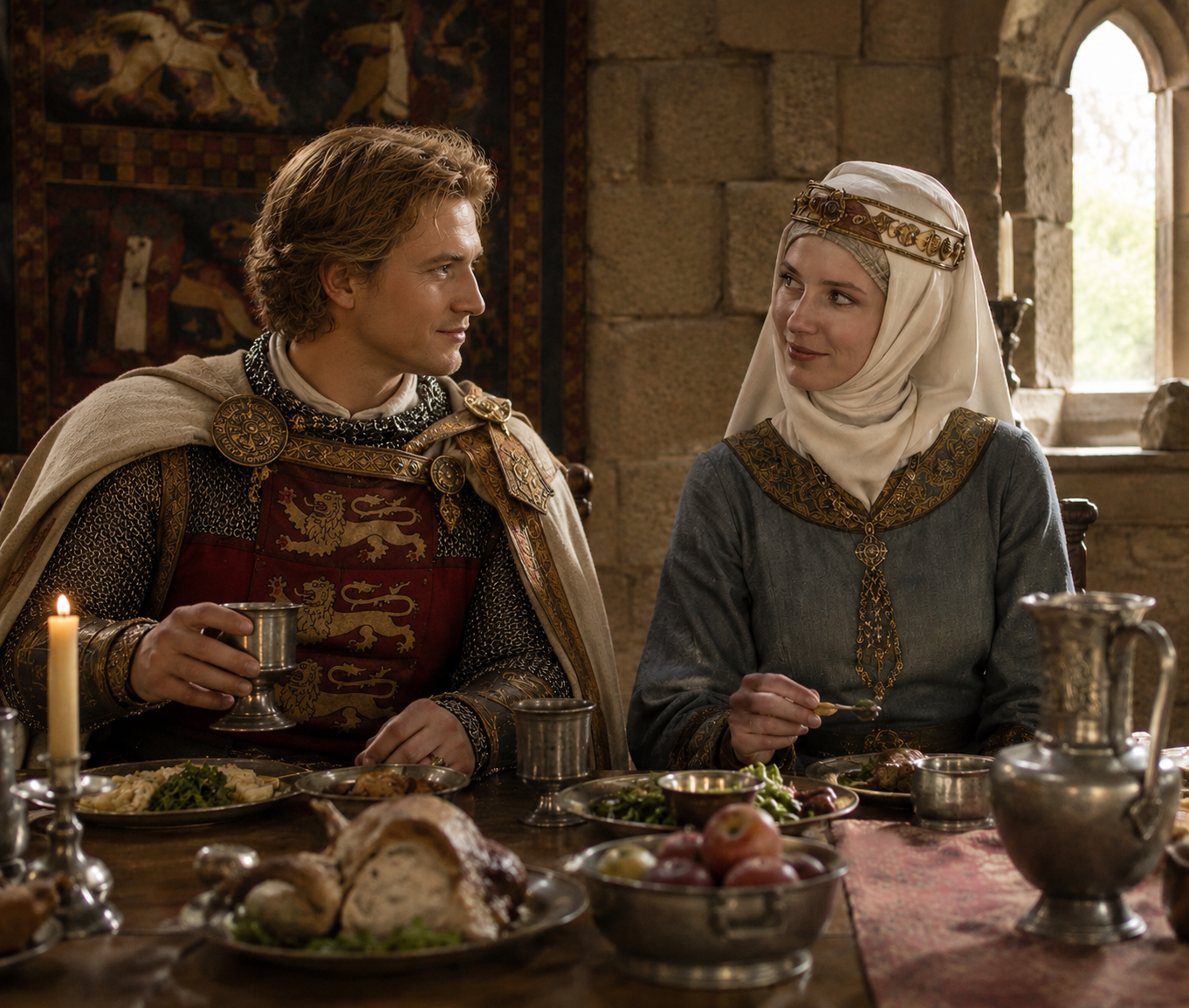
Roland le Strange and his reltive, Barbota
When researching a family as old as the le Stranges, there comes a point when the surviving documents begin to thin out. Charters give us names, places and witnesses, but rarely stop to explain relationships for the benefit of people reading them nine hundred years later.
Sometimes, however, the names themselves give clues.
One of the most intriguing things about the earliest le Strange family is the recurrence of two continental names: Roland — or Riwallon — and Hamon. When we look back across the Channel to the Breton world from which the family's earliest associates came, we find those same names appearing again and again.
And then there is Barbota.
Riwall, Riwallon and Roland
Long before the le Stranges appear securely established in Norfolk, a powerful family was emerging around Alet, Dol, Dinan and Combourg in Brittany.
Scholars including Hubert Guillotel and Michel Brand'Honneur have reconstructed this family from surviving eleventh-century charters.
At its head was Hamon, vicomte of Alet, active in the early eleventh century. His wife was Roianteline, who is herself identified in a medieval act as the daughter of a man called Riwall.
One of their sons was Rivallon or Riwallon of Dol, who became lord of Combourg. His brother Junguenée became archbishop of Dol, while another brother, Gauzlin or Josselin, became associated with Dinan. (Open Edition Books)
So already we have a striking succession:
Riwall
↓
his daughter Roianteline
↓
her son Riwallon
The name appears to have travelled through the family.
The historian examining this pedigree has even observed that Rivallon's name appears to have come from his maternal lineage. (Archives de la Mayenne)
That is worth remembering when we cross the Channel to England.
Among the witnesses associated with Alan fitz Flaald appears a man whose name was written:
Riuallonus Extraneus.
This is the man whom historians of the le Strange family have associated with Roland le Strange.
The spelling should not surprise us. Medieval names were remarkably fluid when Breton, French and Latin-speaking scribes attempted to represent them. Riwallon, Rivallon and the later French form Roland could consequently look rather different from document to document.
What catches the eye is not simply the name. It is the company in which Riuallonus Extraneus appears.
Alan fitz Flaald belonged to the Breton family associated with Dol, and by the early twelfth century he had established himself in England. At Sporle in Norfolk, in the charter concerning his foundation for St Florent, we find Riuallonus Extraneus among his circle.
The coincidence is therefore rather more interesting than finding two medieval men who happened to have similar names.
We have a man called Riuallonus Extraneus, moving within the circle of a family which itself came from the very region of Brittany where Riwallon was already a conspicuous aristocratic name.
Then comes Hamon
This is where the pattern becomes even more curious.
The earlier Breton family begins with:
Hamon I of Alet.
His descendants included another:
Hamon II.
Indeed, the recurrence was sufficiently noticeable for modern scholarship to describe Hamon as a “prénom marqueur” — a marker name — of this family in the region of Dol and Combourg. The research of Hubert Guillotel identified a succession of three vicomtes called Hamon between the late tenth and late eleventh centuries. (Archives de la Mayenne)
Michel Brand'Honneur likewise describes Hamon I and the extraordinary spread of his sons through the important centres of the region: Rivallon at Dol and Combourg, Gauzlin at Dinan and Junguenée in the archbishopric of Dol. (Open Edition Books)
This was therefore a family which recycled names deliberately.
Brand'Honneur has found the same behaviour among other aristocratic families around Combourg. He describes groups in which names were repeatedly reused among relatives and specifically notes descendants whose names were taken directly from their ancestors. (Open Edition Books)
Now return to England.
Our Riuallonus/Roland Extraneus named one of his sons:
Hamon le Strange.
And Hamon did not disappear from the le Strange naming tradition with that first generation.
The name was revived repeatedly among later generations of the family.
That gives us an intriguing reversal:
Breton Alet/Dol family:
Hamon → Riwallon
Early le Strange family:
Riwallon/Roland → Hamon
And both names continued to be recycled within their respective family environments.
The name Rhiwallon comes unexpectedly close to the le Strange story. J. Horace Round's examination of the St Florent records showed that Flaald's own brother was called Rhiwallon. A generation later, Flaald's son Alan fitz Flaald appears in Norfolk accompanied by another Rhiwallon — Rhiwallon Extraneus, identified with the earliest le Strange ancestor. The documents do not tell us how, or even whether, the two Rhiwallons were related, but the recurrence of the name within such a close family circle is difficult to overlook.
None of this proves that Roland le Strange was descended from Hamon of Alet or Riwallon of Dol. Medieval names alone cannot establish a pedigree. But it does make the pattern difficult to ignore, particularly because Riuallonus Extraneus was associated with Alan fitz Flaald's Breton circle rather than appearing in England without any identifiable Breton context. Even more intriguingly, Alan's own father, Flaald, had a brother named Rhiwallon.
And then there is Barbota
Another little clue comes from a later le Strange charter.
John le Strange IV, lord of Knockin, confirmed an old grant at Hunstanton which had originally been made by his ancestor Roland le Strange.
Roland had given sixty acres of land and a messuage to Hervey of Titchwell, in free marriage with a woman called:
Barbota.
The charter describes her very specifically as:
Barbote cognata sua
— Barbota, his kinswoman.
The later Gilbert of Titchwell was described as Barbota's heir.
Barbota is not a familiar English name of the period. Yet when we search the surviving charters of western France around Roland's lifetime, the name suddenly appears.
A charter of 1093 records a Barbota whose daughter inherited property through her.
Another original charter from around 1104 records a woman actually speaking in her own name:
ego Barbota...
She held the church of Saint-Brévin by hereditary right, and the witnesses appearing on her side included important people from the Breton and western Loire world.
So Barbota was not a scribal accident. It was a genuine female personal name in the Breton-Angevin world around 1100.
Even more intriguingly, another Barbota appears in the Châteaubriant circle in Brittany.
Again, none of this tells us who Roland's Barbota actually was. Cognata tells us that she was his kinswoman, but it does not provide the missing family tree.
Nevertheless, the name fits remarkably comfortably into the Continental world from which Roland's associates originated.
Three names worth remembering
We therefore have three names which deserve attention:
Riwallon / Roland
Hamon
Barbota
Riwallon was a recurring aristocratic name in the Dol-Combourg world.
Hamon was so characteristic of the earlier Alet family that a modern scholar has described it as a marker name, and it was repeatedly recycled through generations. (Archives de la Mayenne)
And Barbota, the unusual name borne by Roland le Strange's own kinswoman, can independently be found among women of the Breton and western French world during the generations immediately surrounding Roland.
Then, in Norfolk, we find Riuallonus Extraneus in the company of Alan fitz Flaald, whose family had come from Dol.
Later we find Roland le Strange with a son called Hamon and a kinswoman called Barbota.
Coincidence remains possible. Medieval genealogy is full of tempting patterns which disappear when subjected to documentary scrutiny.
But historians themselves use repeated personal names as one piece of evidence when reconstructing these poorly documented Breton aristocratic families. Brand'Honneur's work demonstrates just how strongly names could repeat within the interconnected families around Combourg. (Open Edition Books)
So the names cannot tell us how Roland le Strange was related to these Breton families.
They cannot give us a missing father or grandfather.
But taken together with the charters, the places and the people around him, they do something perhaps almost as valuable.
They tell us where to keep looking.