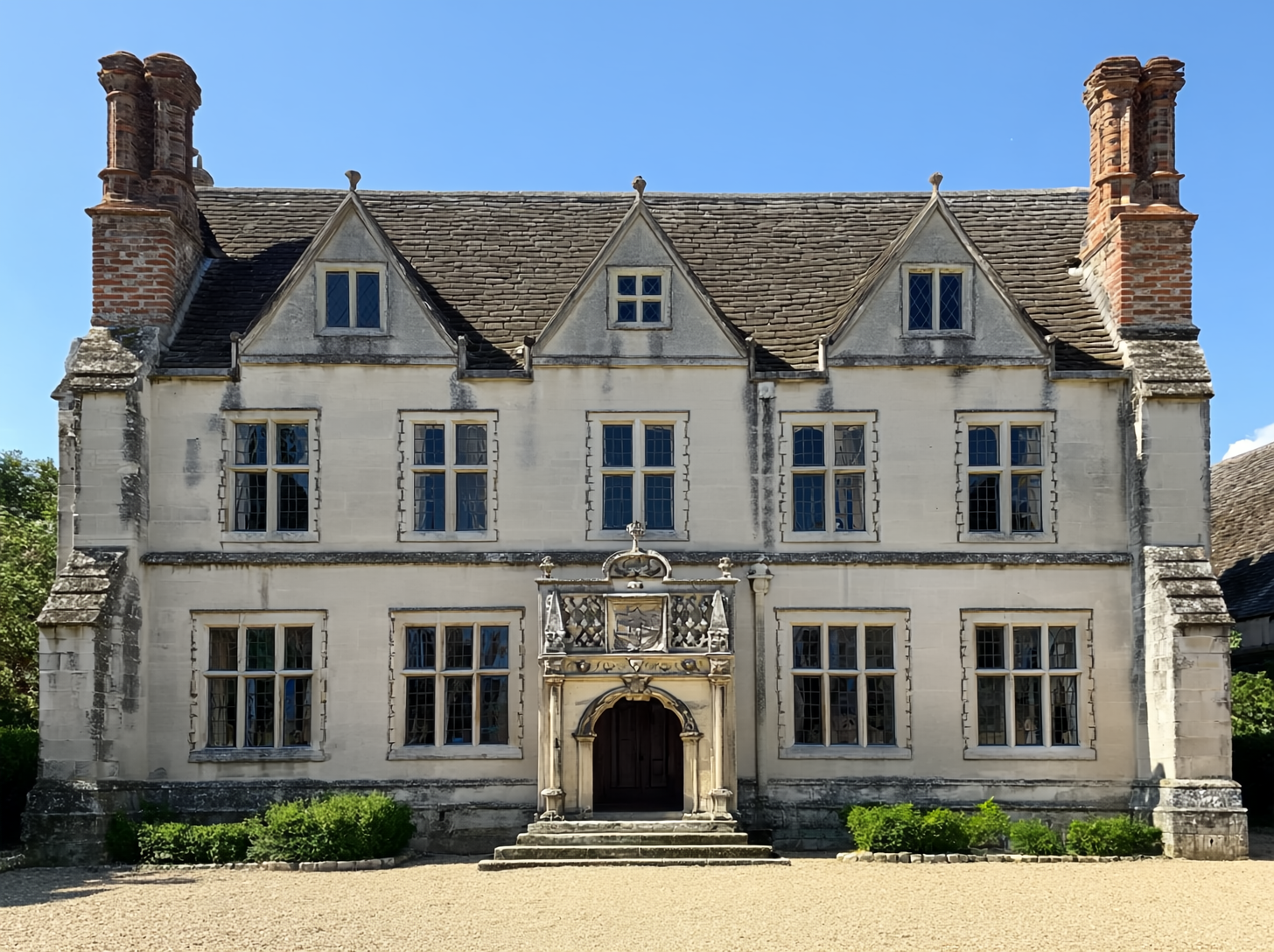
le Strange Family Grade 1 Listed Porch
THE LOST WING OF HUNSTANTON HALL
This reconstruction image closely represents the appearance of the lost Elizabethan Wing of the house. While it is not an exact replica, it was very similar.
THE ELIZABETHAN WING
Fire at the Hall, Spring 1853
A fire began in the attic floor of this Elizabethan block of the Hall on the morning of 5 April 1853. The housemaid in charge, Mary Paul, had lit a fire the previous evening to air bedding and believed it had been safely extinguished before she went to bed. During the night, however, a beam in the chimney—possibly smouldering for some time—was reignited by a draught.
At approximately 6 a.m., gardeners arriving to mow the lawn noticed smoke coming through the upper windows and immediately raised the alarm. By the time help arrived from the village and surrounding area, the fire had taken hold and it was already too late to save the Elizabethan section of the buildings.
Villagers and tenants worked to remove furniture, books, pictures, and other contents from the lower floor. Household possessions were carried out and temporarily stored in neighbouring barns, the school, and even the church.
A family friend, John Rolfe of Heacham, arrived with his brother and their small fire engine. At that time there was no fire engine stationed in Hunstanton. Rolfe organised two lines of men forming a chain from the moat to the burning hall. Hundreds of volunteers passed buckets of water along the line to supply the engine.
Efforts focused particularly on protecting the heavily carved oak door at the north end of the Tenants’ Hall. If the flames had reached the grand staircase beyond, it was believed that the Great Drawing Room and adjoining rooms would have been lost.
Around midday, the roof collapsed along with a large stack of chimneys. By 4 p.m., the flames were brought under control. However, the building continued to smoulder for several days and remained under constant watch to prevent the fire from breaking out again.
The destruction of the historic house caused lasting distress.
News of the fire spread rapidly through the village. Many residents immediately left their work to assist, and women reportedly ran with pails to join the bucket chains. When the milk cart passed through Hunstanton that day, the driver described the village as largely deserted, with only very elderly men and infants remaining.
In recognition of the assistance given during the emergency, the owner of the estate later presented John Rolfe with a silver inkstand bearing a commemorative inscription. Framed lithograph portraits of the Henry & Jamesina Styleman le Strange —produced in Brussels by Bangnler—were also distributed to many tenants the following year. Additional gifts included books and other items for the men who helped, and clothing for the wives of estate workers and labourers.
THE PORCH & INTERIOR
The fire of 1853 left only the remains of the 1618 porch as shown, which was ultimately the principal entrance to the Hall for many centuries.
Situated centrally within the Courtyard, the Porch ruin bears the date 1618, indicating that it was constructed at a later date than the rest of the wing. It has been designated Grade 1 Listed.
The doorway projected slightly from the main façade, forming a shallow porch. The the heavy door was likely made from oak.
It opened directly into the large room known as the Tenants Hall, which was customarily used as the main dining room. Whereas, breakfast was served in the South Dining Room.
The Tenants Hall room measured approximately forty feet x twenty feet wide.
The east wall contained two large stone-mullioned windows overlooking the Court. At the north end, a row of small, high-set windows admitted light from a small leaded court situated above the wine cellar. Those upper windows of decorative stained glass with coats of arms, including those of Hastings and Camoys were all destroyed in the fire.
The floor consisted of large flagstones, largely covered with Indian matting. The infamous old Turkish carpet given by the Shah of Persia, was laid centrally – the very one belonging to Armine le Strange (see Ghost) saying that her curse would light on her reckless son Nich – (The Jolly Gentleman) – if he dared sell it!
The walls were wainscoated with dark oak panelling, & above this panelling, hung many suits of armour. These included both chain-armour & plate armour; the Helmets with visors. They were “partly up looking and most lifelike”, only a few fragments survived the Fire & were preserved and kept in the Orangery.
The stone Fireplace reached to the ceiling - the type you could stand inside the hearth, look up & see the sky! Only huge logs of wood were burnt, every day of the year including the height of summer!
Some symbolic iron dogs represented guardian couchant hounds. The upper part of the chimney piece bore the arms of le Strange and Lewknor. This Sir Nicholas le Strange, was created a Baron on 1st June 1629.
Between the fireplace and coat of arm was a useful stone carved stag’s head on whose antlers a silver toasting fork would hang. There were two high armchairs either side of the fireplace and an oriental draft-proofing screen to deter draughts entering from the door. The rest of the room had the dark oak furniture arranged around the walls, and this Tenant’s Hall was aptly named for the room where Estate staff were received on business terms with the Lord.