Le Strange Barony of Knockin and it’s Monuments
-
![]()
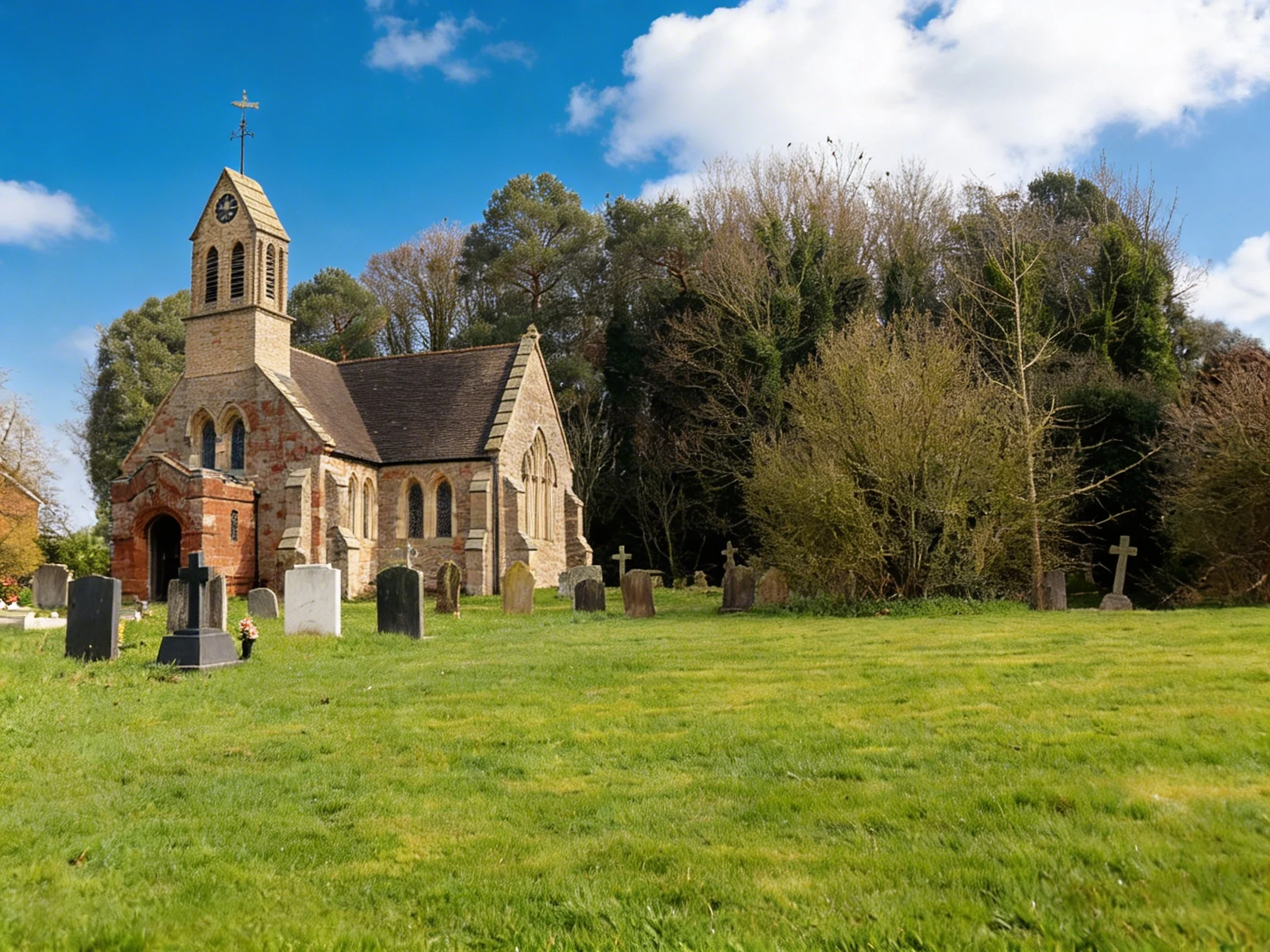
Castle (right) 12th C. Chancel (left)
-
![]()
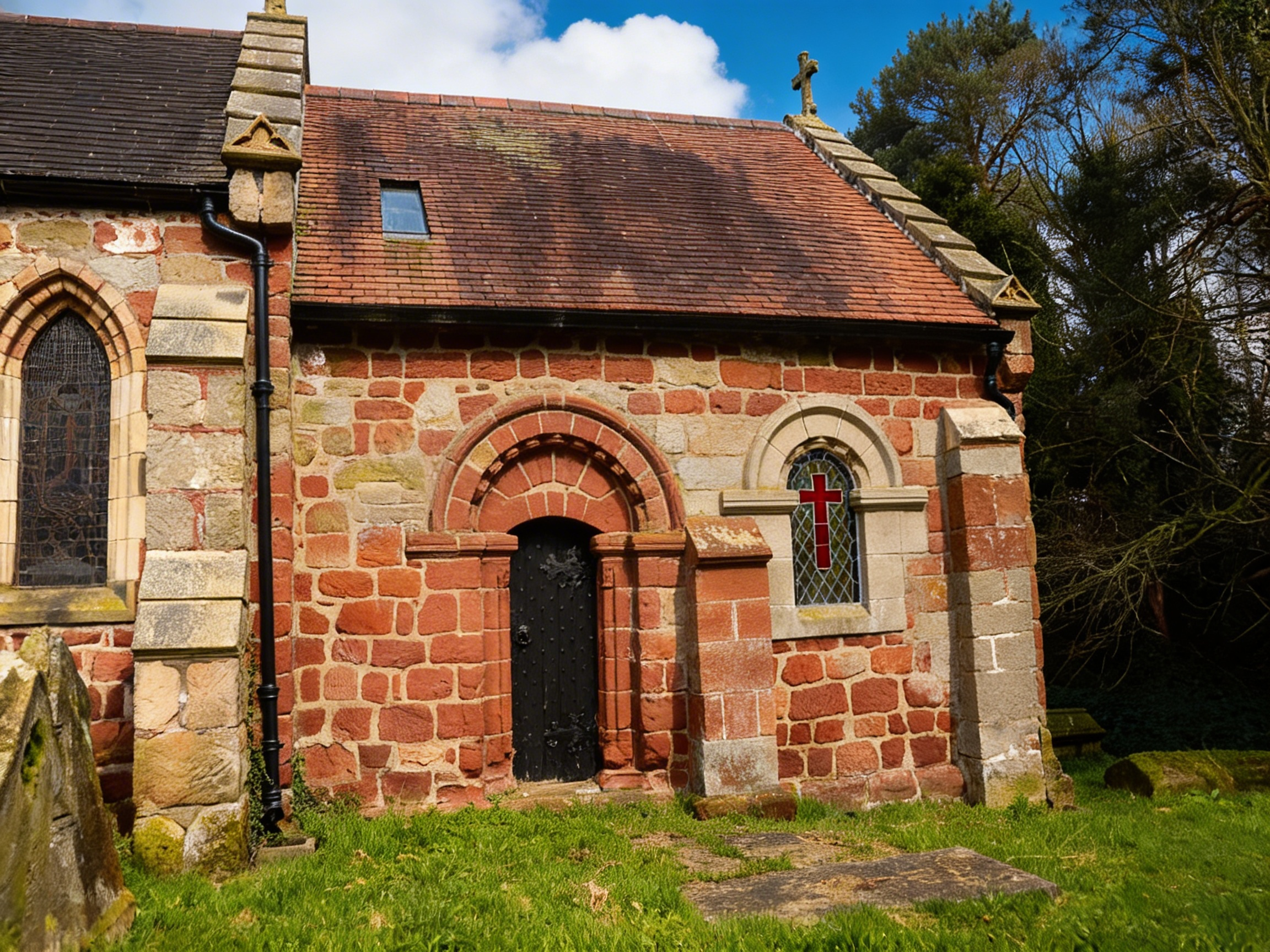
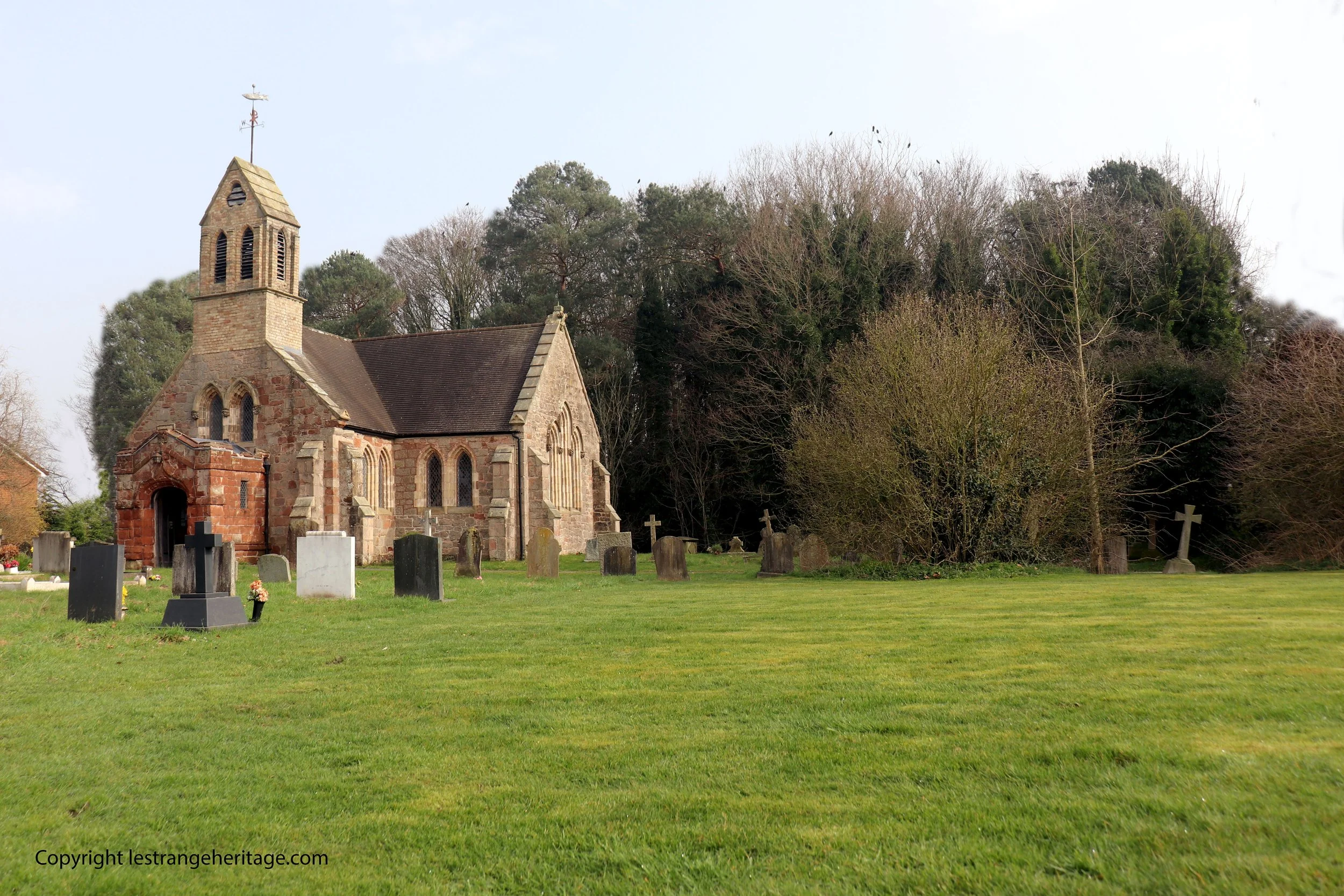
St. Mary’s Chapel, Knockin c.1190-1195
-
![]()
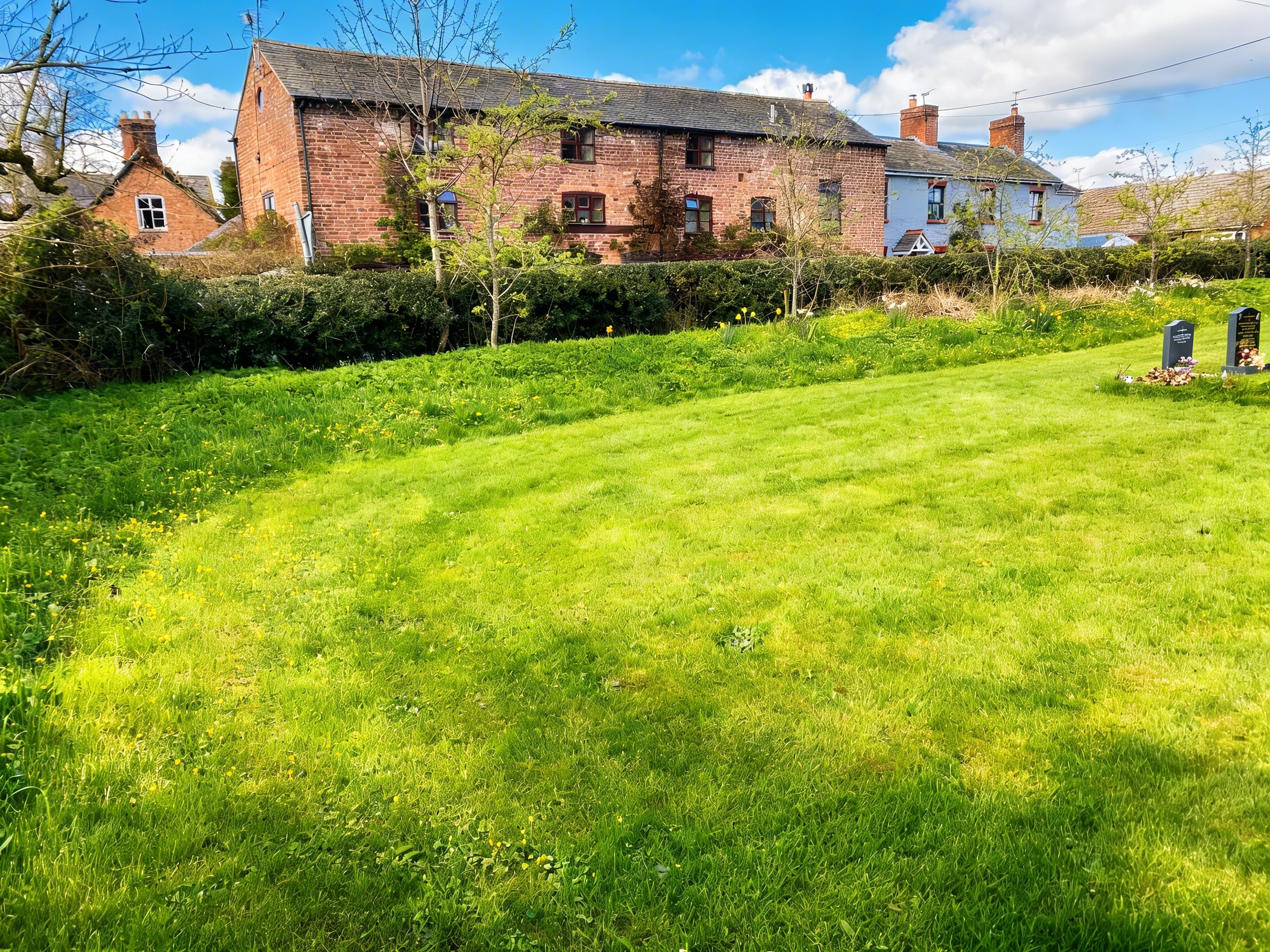
Cemetary Boundary or Outer Castle Bailey...
-
![]()
Inner Castle Ward (left) Outer Ward & Church (right)
-
![]()
Sluice Gates?
-
![]()
Castle (woods) & St. Mary's Church
-
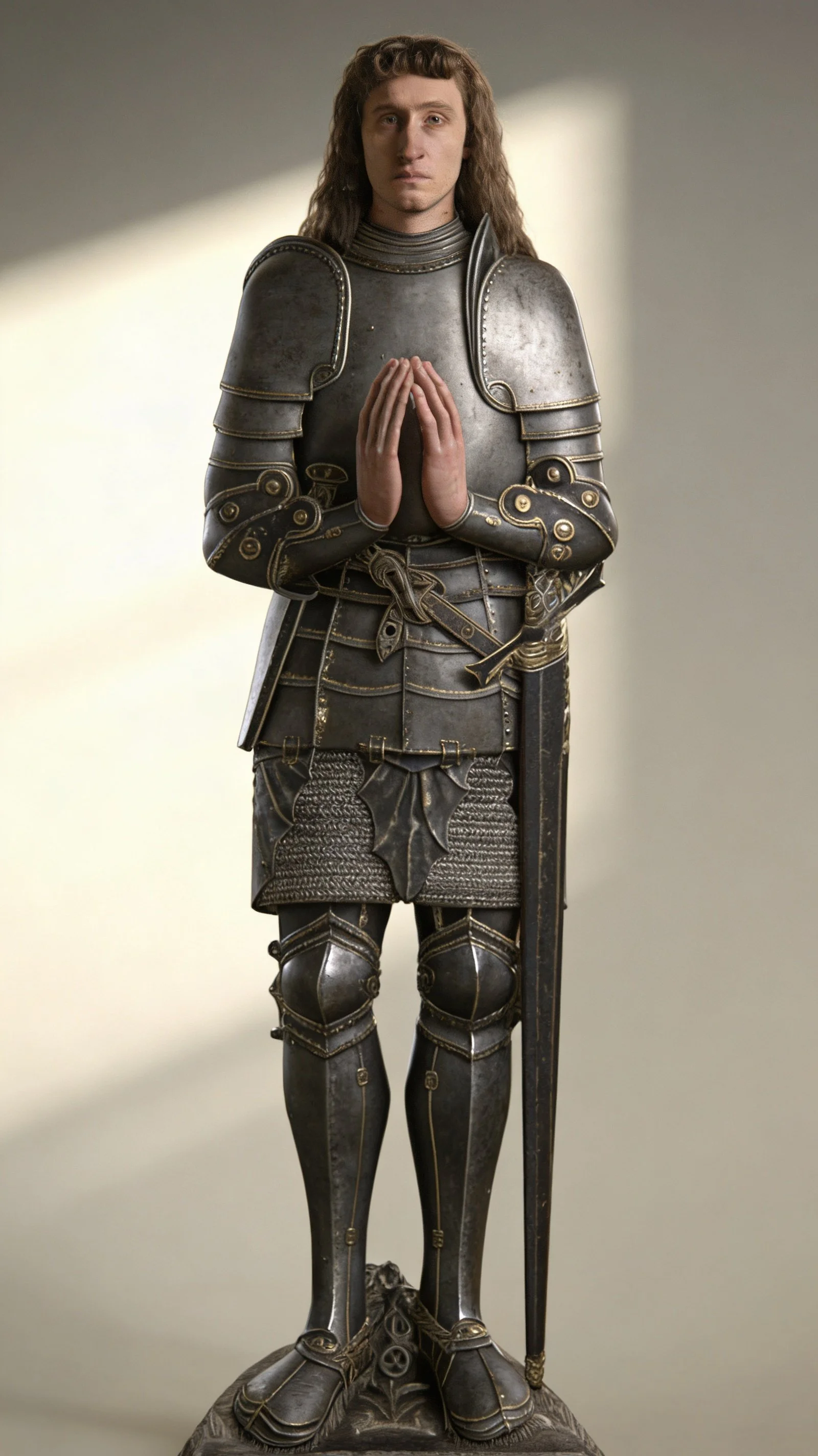
![Rendition of Lord John le Strange (8th Baron) Knockin]()
Rendition of Lord John le Strange (8th Baron) Knockin (d.1479)
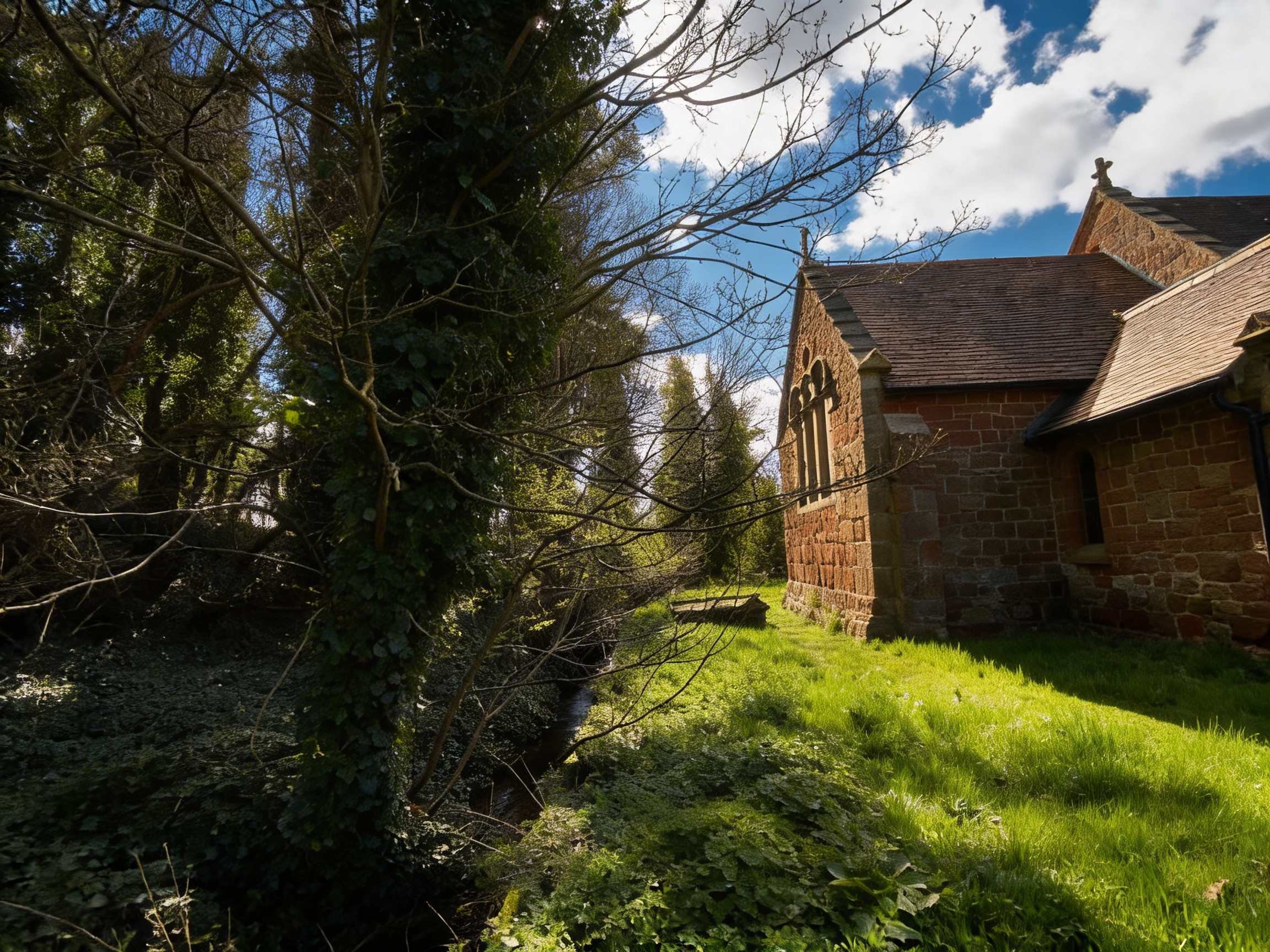
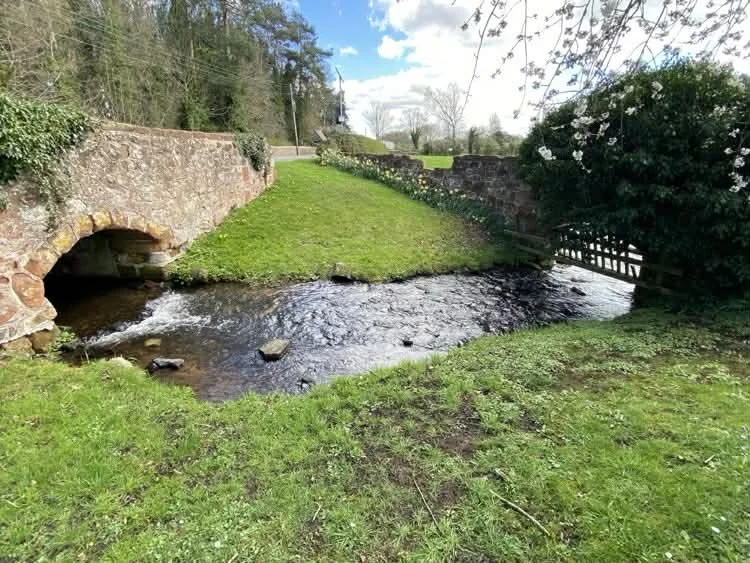
KNOCKIN VILLAGE HISTORY
The True Story of the le Strange Family and the Medieval Welsh Marches of Knockin
Few villages in Shropshire preserve such a remarkable connection between medieval lordship, family history, church patronage, and surviving landscape as Knockin.
Today, the village appears peaceful — a rural settlement clustered around lanes, fields, and the familiar silhouette of St Mary’s Church. Yet beneath the quiet earth lie the remains of one of the Welsh Marches’ most important frontier strongholds: Knockin Castle, once the seat of the powerful le Strange family.
For nearly four centuries, the Lords Strange of Knockin stood among the most influential marcher dynasties on the border between England and Wales. Their story is one of loyalty to kings, castle-building, military power, royal marriages, political survival, and gradual transformation from frontier warlords into noble courtiers close to the English Crown.
Though the castle itself has long since faded into ruin, the story of Knockin still survives — in its earthworks, its church, its landscape, and in the descendants of the family itself.
This is the true story of Knockin Castle and the rise of the le Strange family.
A Village on the Frontier
In the twelfth century, Knockin stood within one of the most dangerous regions in England: the Welsh Marches.
This was not an ordinary county boundary. The Marches formed a volatile military frontier where Norman lords ruled with extraordinary independence, defending England’s western border through castles, armed retinues, and private authority. Occasional raids, shifting alliances, and political uncertainty were part of life.
Knockin’s position made it strategically valuable. On the hillock (celtic: Cnuc) — the settlement evolved from being Osbaston into what became known as “Cnuc-kyn” inhabited by the kin of the Cnuc, who as we shall see, became a le Strange family heirloom which initially passed between two brothers and their close relatives.
What began as a modest frontier manor would eventually become the principal seat of the elder branch of the le Strange family of Hunstanton. The castle stood within “fire and smoke” signalling distance of allied strongholds at Ness, Oswestry, and Shrawardine, linking the le Strange family with their powerful FitzAlan overlords.
From these castles, messages could be transmitted rapidly across a few miles of countryside in times of danger, and the le Strange era began during one of the most turbulent periods in English history — known as The Anarchy of King Stephen’s reign.
The Coming of the le Stranges
At this time, the Country was confused, since the loss of Henry I left only his daughter, Matilda, to reign as the first potential female Queen — which, to many — was unheard of. Throughout King Stephen’s 19 year reign when he used magnetic charm to aide support of his kingship, her title was reduced to Empress.
On December 19, 1154, King Henry II emerged victorious from the two decades of civil war. King Stephen’s death came at a timely date for Henry II was now of age, and was old enough to be crowned. This brutal struggle that had shattered royal authority across England and was determined to restore order, by rewarding loyal supporters who had stood by him during the chaos.
Among them was a Knight of Breton descent, named Hamon le Strange. The second son of the Breton, Roland le Strange, and his wife Matilda of Hunstanton in Norfolk, a family whose origins lay in Brittany near Dol-de-Bretagne. The le Stranges were closely connected, if not affiliated, to another great marcher Family: the FitzAlans, Lords of Dol-de-Bretagne, then Oswestry and Shropshire.
It was around the accession of Henry II in 1154, when Hamo le Strange acquired Osbaston, the estate from which the later lordship of Knockin developed. Osbaston had previously been held by the Haughton family under the FitzAlans. Renowned historian, Eyton concluded that a member of the Haughton family transferred it to Hamo at about this time.
The original grant has not survived, so the precise circumstances of the transfer are unknown. Significantly, however, the Haughtons' superior lordship was not forgotten: generations later the le Stranges were still recorded as holding Knockin under the Haughton family.
The Haughton lord, c.1155: negotiating the transaction was probably Roger fitz Henry (de Haughton), although possibly his father Henry. The surviving evidence does not identify the Haughton who transferred Osbaston to Hamo le Strange. Roger Haughton is the first securely documented head of the family 5 years after Hamon’s death as a FitzAlan tenant in 1165.
The original agreement has not survived, so we cannot identify the Haughton lord with certainty or know what Hamo gave in return. Later medieval records show the Haughtons holding a superior interest in Knockin, but without the original mid-twelfth-century transaction we cannot establish whether this represented an uninterrupted continuation of the Haughtons' earlier lordship or a later arrangement made over 100 years later in 1276.
At first glance, Osbaston was little more than farmland providing income. But the Crown understood its importance. Whoever controlled these lands controlled roads, trade routes, military movement, and access between England and Wales.
His main seat at Cheswardine Castle after holding Wellington meant that Osbaston to Hamon was farmland income, however, it was Hamon who established the first le Strange foothold here, beginning a connection that would last centuries.
The Brothers
Hamon had 3 other brothers that we know of: John (eldest), Guy (3rd oldest), and Ralph (4th oldest). However, already his time at Knockin was running out.
By 1159, only four years into his Lordships, the records suggest that something was wrong. Hamon appeared less frequently, while his elder brother John increasingly stepped forward in family affairs. In an age when records were sparse, such changes often suggested illness or impending death.
Within months, Hamon le Strange was dead. Although he was a seasoned Knight who had survived The Anarchy years, his time had been tragically cut short.
His death in 1160 came during times of upheaval across the Marches, when Powerful rulers and lords were vanishing almost simultaneously, including his comrade, the mighty William FitzAlan, Sheriff of Shropshire.
The inheritance of their tenure, was carefully managed so that the natural heir, John le Strange I, inherited Hamon’s home of Cheswardine Castle, while retaining Ness Castle near Knockin. John also maintained the family’s interests in their Norfolk Estates, while their 3rd brother, Guy living some 30 miles south of Knockin at Alveley in Bridgenorth, inheritted Hamon’s Osbaston farmlands, making up part of his income.
At this time, a few months had passed since the King had appointed Guy, according to tradition, as the guardian of the young fitz Alan heir. William FitzAlan was dead and his son was only 6, and couldn’t succeed his father in the major royal official role in the County for another 15 years.
Guy, therefore, was appointed his late comrade’s Office of Sheriff of Shropshire and Warden of Oswestry by King Henry II, empowering the son of Roland le Strange, with one of the most powerful offices in the County, passing with it, control of Osbaston.
It was Guy who would transform the settlement forever.
Guy le Strange and the Founding of Knockin Castle
Guy le Strange is remembered as the founder of Knockin Castle because the name, Knockin, came into being during his and his Family’s tenure. He was a powerful Lord, whose first grant from the King was Alveley manor, Bridgenorth, Shropshire, where he was usually keeper of two important Royal Castles and their Garrisons, of Bridgenorth and Shrewsbury.
During these years of his Lordship, Knockin rose dramatically in importance when we fine fewer refences of Osbaston and more of Knockin Castle.
The castle’s was raised above the community, on the hillock with a surrounding moat which was fed by water diverted from springs nearby.
Guy’s position as Sheriff of Shropshire gave him enormous authority over 15 years (which included a 5 year interval).
He collected taxes, oversaw royal justice, controlled military readiness, and maintained order in one of the kingdom’s most unstable regions, but would still be entitled to a day off on Sundays — when not participating in combat.
He married twice, and it’s accepted that his sons were born through his first wife of which we do not know her name, however, his second wife was named Mary.
During his consolidated 10 years in Office with control over Shropshire, including Haughmond Abbey, the era of le Strange influence allowed Haughmond to continue flourishing. The le Stranges had been major beneficiaries from the outset, and 1160–1175 (minus 5 years=10yrs) consolidation and steady growth under the protection of the FitzAlan–Le Strange network continued.
It was his son, Ralph who would succeed to the Lordship of Knockin, on his death in 1179.
Knockin Chapel
Along with the castle came the establishment of their chapel referred to throughout, as Knockin chapel. This may cause confusion between the current Church of St. Mary which was erected east of the mound. For hundred’s of years after the le Stranges had left, the Earls of Bradford had owned the Knockin Estate. The site has become archaeologically intriguing, having been altered manually, posing a challenge for me as a descendant, to discover the mysteries, of original Knockin.
A standard castle layout would include a moat surrounding the Lords private living quarters, blocked by a high security drawbridge and towers, detaching it from the rest of the outer bailey via the moat and security. It is only my introspection, that the Knockin Chapel referred to in the Haughmond Abbey Charters, was different to the St. Mary’s that stands by the castle today, and that a chapel in the bailey to the east of the mound would not have been out of place.
The Church of St. Mary, with some obvious subsidence, a mix of materials, and faux Norman arched pillars which adhere to the North internal wall, speaks volumes of the character of the later ownership, of the Earls of Bradford, who are known to enjoy glamorous, creative architectural projects. Re-purposing antiques, reclaming materials, and stone blocks for a church is not out of the question. Historic England appointed this a standard Grade II listing, and although states without evidence that Ralph le Strange founded this building, it also states that the church appears to include Norman design, while the internal painted walls appear to be newer 1700’s.
Most importantly, the west-south cemetery aligns perfectly with the adjacent ‘sluice gate’ across the road for water control. This suggests that the Church’s subsidence strongly indicates that St. Mary’s Church is out of place, and built on the original moat site, and that the leat whic detacjes the Church from the tree covered mound was created for drainage during the Earls of Bradford lordship. However, there is no evidence either way, and these are just suggestions which help to untangle the mysteries of his altered site.
Founder Of Knockin Chapel
For a medieval lord founding a new seat of power, a chapel was essential, and this Chapel is possibly one that was situated inside the castle outer bailey.
Although the current church or chapel that may no longer be in existence today, has traditionally been dated to around 1190–1195 due to the lifespans of Ralph and one of the witnesses (William le Strange) who has been mistaken for another William of a later generation. The evidence strongly suggests that an earlier chapel already existed during Guy le Strange’s lifetime at his castle, before 1179. But this was a chapel not a church and may have been inside the bailey instead.
The key evidence for an earlier date survives in a charter issued by Guy’s son, Ralph le Strange:
“To all… Ralph Lestrange sends greetings… Let all of you know that I have granted… to the church of St John of Haughmond… the right of patronage of the chapel of Knockin forever…”
This is just a standard advowson — the hereditary right to appoint priests to the local Haughmond Abbey. This strongly implies that the chapel (not necessarily the current St. Mary’s Church) was inherited by Ralph, and had existed before he succeeded his Father Guy.
If the Chapel was founded by a le Strange, then it was most likely to have been Guy, and that intuitively, I feel that the Chapel was ruined along with the Castle.
The ‘apparent’ Norman architecture of St Mary’s Church, still hints at those formative years when the le Strange family established Knockin castle and it’s chapel, and is a grounding reminder to all who enter that prayer and reflection were an important part of medieval lives.
A Marcher Dynasty
Across twelve generations, the 15 Lords Strange of Knockin achieved something extraordinary.
While many marcher dynasties disappeared through rebellion, war, or failed succession, the le Stranges preserved an almost unbroken line of male heirs for centuries. Fifteen successive male inheritances carried the family through political turmoil, dynastic conflict, and changing royal regimes.
Their influence spread across Shropshire and beyond. Through military service, royal favour, marriage alliances, and strategic landholding, the family became one of the great powers of the border region.
Yet the world around them was slowly changing.
The violent age of marcher lordship — built upon castles, frontier warfare, and feudal loyalties — gradually began to give way to a more courtly and centralised England.
The le Stranges adapted.
Lord John le Strange and the Royal Court
The most remarkable chapter of the family story belongs to the last of the male line, Lord John le Strange, born at Knockin Castle on 20 May 1444.
Losing his father in infancy, John nevertheless rose rapidly into royal favour. At only eighteen years old, he received his knighthood during the coronation celebrations of Edward IV in 1461.
The connection between king and nobleman soon became entwined.
John married Jacquetta Woodville, sister of Queen Elizabeth Woodville, making Lord John the brother-in-law of the King himself. Edward IV and John were of similar age, and their wives were sisters. The two couples moved within the same powerful dynastic circle at the very centre of English politics.
A year later, the couple celebrated the birth of their daughter Joan.
For a brief moment, the le Strange family of Knockin stood among the closest noble connections to the English Crown, together with their Norfolk counterparts.
From Frontier Castle to Courtly Life
By the fifteenth century, the family’s focus had shifted far from the rugged borderlands of medieval Knockin.
One of Lord John’s most important possessions was Colham Manor near London — a substantial estate extending across Hillingdon, Cowley, and Ickenham. Strategically positioned close to the royal court, it likely became the centre of John and Jacquetta’s married life, and was within easy reach of the Royal Palaces.
The medieval world was changing.
Power increasingly flowed not from isolated frontier castles, but from proximity to the king, influence at court, and residence in fashionable estates closer to London.
Knockin Castle itself may already have begun to lose importance.
Lord John died in 1479 at only thirty-five years of age, leaving Joan as his heir.
Joan later commissioned commemorative brasscarving of her parents, while her successful marriage to Sir George Stanley, Earl of Derby, ensured the continuation of the bloodline into future centuries.
The End of the Marcher Lords
The final chapter of Knockin Castle came during the reign of Henry VIII.
In 1535, during the lifetime of Joan’s son, the Crown finally abolished the old marcher lordship system that had dominated the Welsh borderlands for centuries. The unique frontier world that had created families like the le Stranges disappeared forever.
By then, Knockin Castle itself had already fallen into decay.
When the antiquarian John Leland visited around 1540, he dismissed it curtly as:
“a ruinous thing.”
Yet while the castle crumbled, the le Strange legacy endured.
There is something fitting in the timing. The family’s succession survived almost exactly as long as the marcher order itself — as though the male succession line of the le Stranges had remained just long enough to complete their centuries-long role guarding England’s western frontier which has barely changed today.
The le Strange Sword
One final story survives from the family’s long history — a curious and deeply evocative mystery.
In the village of Hanmer, some twenty miles from Knockin, Lord John had once rebuilt St Chad’s Church after a devastating fire around 1463. More than five centuries later, in the 1990s, descendants of the le Strange family visited the church and made a startling discovery.
Mounted upon the church wall hung an ancestral le Strange sword.
The object had seemingly passed through generations, surviving wars, reformations, and centuries of upheaval. Local tradition claimed the weapon had once been used in Ireland by a member of the le Strange family who were related to the Hanmer lords.
The discovery sparked renewed fascination with the medieval le Stranges and their forgotten frontier world. Most remarkable of all, the sword is understood still to survive today in the care of the Hanmer family — a rare physical survivor from the age of Knockin Castle itself.
The Legacy of Knockin
Today, little remains of Knockin Castle above ground.
Yet the village still preserves extraordinary traces of its medieval past.
The earthworks of the inner ward survive within woodland beside the church. St Mary’s still stands upon what was once the castle’s outer bailey. The landscape itself continues to reveal the outlines of the moat, water systems, and defensive works that once guarded the frontier of England.
Visitors passing through Knockin may stop at The Bradford Arms beside the castle grounds, scarcely realising that beneath the quiet fields lies the memory of one of the Welsh Marches’ great medieval lordships.
The castle may have vanished. But the story remains.
Few Shropshire villages preserve so clear a connection between marcher lordship, family patronage, ecclesiastical history, and surviving architecture as Knockin.
Once home to the le Strange Family, the old village evolved with these Marcher Lords, they settled in this small farming community sheltered by a hillock (Cnuc). The Village rose to prominence alongside the lowland Castle, and from this stage onwards became ‘Knoc’ Kin (“Cnukyn“)
The frontier Castle with distant views of Wales, was conveniently situated within ‘fire & smoke’ signalling distance of their comrades, linking communication systems between siblings at Ness Castle, and their Chief Fitz Alan overlords at Oswestry and Shrawardine Castles.
Knockin is worth passing through for it’s pub, The Bradford Arms, located adjacent to the monumental site where two protected monuments exist as part of the Castle grounds, attributed to the le Stranges.
These include groundworks in the wooded area (Castle Inner Ward) and a building which is the current Church of St. Mary (Outer Bailey).
The Church is still used by the local community for worship which was the original purpose, however it was not consecrated for burials until the early 19th Century.
Owing to later site interventions, the earthworks and water system remain archaeologically intriguing. However, it does have a well documented history around the le Strange family who were evidently active in the Village between 12th and 15th century, and it appears that the last record of a birth at Knockin Castle was that of Lord John le Strange (8th Baron) on 20th May 1444 of which more later, but for now lets go back to the beginning.
Orphaned of his father in infancy, John le Strange rose swiftly into royal favour, receiving his knighthood at just eighteen years of age, during the coronation of Edward IV on 28 June 1461. The connection between King and nobleman was unusually close: Lord John’s wife, Jacquetta Woodville, was sister of the Queen Consort, Elizabeth Woodville. The King and Lord John le Strange were the same age, and their wives were sisters brought them together as brother-on-laws.
A year after his knighthood, John and Jacquetta celebrated the birth of their daughter Joan, and the le Strange family of Knockin found themselves at the very heart of one of medieval England’s most powerful dynastic circles.
Of all Lord John’s possessions, Colham Manor appears to have held particular importance. More than simply an estate, it was a substantial lordship extending across much of the fashionable parishes of Hillingdon, Cowley, and Ickenham — a strategically placed retreat within easy reach of London and the royal court.
It is likely that they may have spent much of their married life there at their medieval manor close to the bridge over the Grand Union Canal. The residence has long since vanished, but it is intriguing to imagine the young Lord Strange — brother-in-law to Edward IV — moving between Colham and the royal palaces, never far from the centre of power.
The couple eventually came to rest at Hillingdon, and what became of Knockin Castle during this time we cannot know. He left this world with several lordships; of Knockin, Mohun, Wasset, Warnell and Lacy, and “Lord of Colham,” suggesting it’s significance in his identity and status.
He was only 35 years old when he died in 1479, leaving his daughter as his successor. She was later to commission a commemorative brass relief carving of her parents and her successful marriage to Sir George Stanley, Earl of Derby produced children to continue the line to this very day.
KNOCKIN CASTLE LEGACY
It was in Joan’s son’s lifetime, in 1535, when Henry VIII closed the chapter on powerful Marcher Lordship systems. The uniquely turbulent era of border history had now passed.
But what of the legacy? Knockin Castle had already crumbled into neglect — so unimpressed was historian John Leland about 1540 that he curtly labelled it “a ruinous thing” before moving on — but the le Strange legacy proved harder to dismantle.
Remarkably, the le Strange male line survived just long enough to witness the world they had dominated disappear around them. Though the male line ended with Lord John, there is dignity in the timing: the family’s succession endured the Marcher order itself, as if the le Stranges had stayed on just long enough to complete their work in safeguarding England’s boundary, which has barely altered today.
Their Knockin Estate passed to the Stanley Earls of Derby and it would appear that both Joan and her parent’s generation had experienced modern living, away from old Knockin Castle, which had once served them and their neighbours.
THE LE STRANGE SWORD
Before continuing with the history, there is a delightful little tale connected to one of Lord John’s other estates, some twenty miles from Knockin, in the village of Hanmer, Shropshire.
During his daughter’s infancy, around 1463, disaster struck Hanmer when a devastating fire damaged the village church of St. Chad’s. Lord John commissioned the rebuilding of it, and little could he have imagined that more than five centuries later, the church would still hold a remarkable interest with the Family, and a surprise.
In the late 1990s, a le Strange descendant, Mary Meakin, visited St. Chad’s accompanied by her elderly uncle, Hamon le Strange of Hunstanton Estate. As they stepped inside, they were astonished to find what appeared to be a le Strange ancestral sword mounted on the church wall — an object seemingly transported through time, quietly hanging in plain sight.
That discovery sparked further curiosity — particularly for Mary’s daughter (myself), who began digging deeper into the mystery. A recent conversation with the vicar revealed an intriguing thread of continuity. He recalled that the late Sir John Hanmer had displayed the so-called “le Strange Sword” during the locally organised Millennium Exhibition in 2000, exhibiting it on the wall of the church. According to Sir John, the sword had been used in Ireland by one of the family’s le Strange ancestors.
The Irish connection adds another layer of fascination. John, 8th Lord Strange of Knockin, was also 4th Lord Mohun of Dunster — a family long associated with legendary ties to Ireland. While there is no firm evidence linking the sword directly to this particular Lord Strange, Hanmer had formed part of the le Strange estates as early as 1342, making the story all the more tantalising. Most remarkably of all, the Hanmer family are understood still to retain the sword today — a rare and evocative survivor of a distant medieval past.
T
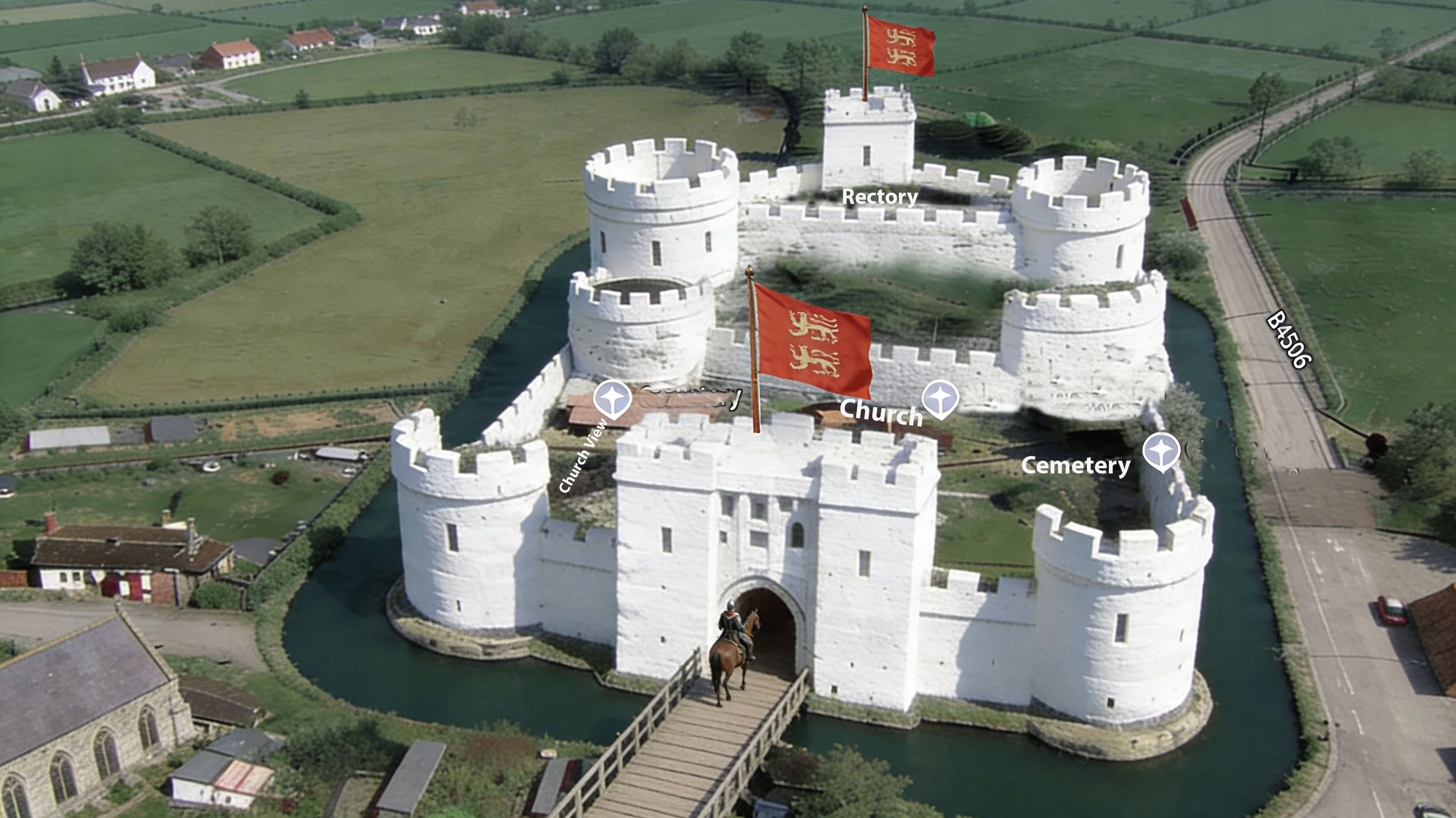
Knockin Castle (Guestimate)
How it may have looked including lime render
KNOCKIN VILLAGE
12th Century
THE PASSAGE OF TIME
Across twelve generations, the 15 Lords Strange of Knockin achieved something few Marcher dynasties managed: an extraordinary succession of fifteen male heirs, preserving both title and influence through centuries of border conflict, political upheaval, and dynastic uncertainty. Their endurance set them apart from many neighbouring Marcher families, including the once-powerful FitzWarin lords of Whitchurch (Blancminster), whose fortunes faded long before lands and influence passed into le Strange hands during the thirteenth century.
Yet history was changing. As the Tudor age dawned, the rugged world of the Marcher lords — forged in castles, feudal loyalties, and frontier skirmishes — began to give way to something altogether different. Power was shifting from fortified strongholds to grand country houses and proximity to court. While the le Strange family in this region adapted to life in larger, more modern residences, their relatives at Hunstanton in Norfolk remained likewise, firmly within the orbit of royal favour, continuing to move with ease in the company of kings.
But what if we were to go back in time, and find out how it all began?
“To all…Ralph Lestrange sends greetings,,,. Let all of you know that I have granted….to the church of St John of Haughmond, and the canons…and my successors, the right of patronage of the chapel of Knockin forever….'“ DATED: c.1179-1195 [Ralph le Strange d.1195 Haughmond Chartulary No: 666]
“To all….John Lestrange sends greetings. Know that I have given and granted to..the canons of Haughmond (Abbey),…the whole 4th part of the vill of Cheswardine, with all its appurtenances… and the whole land of Norslepe (North Slope) with the upper fishpond next to my castle of Knockin, ..for them to exchange the said land of Norslepe at their pleasure ..without challenge from me or my heirs.” DATED: 1209[1209 From John le Strange II (No’s: 1178-1234) [Haughmond Chartulary]
THE 2 BROTHERS
HAMON LE STRANGE (1155 -1160)
GUY LE STRANGE 1160 -1179
In the year 1155, winds of change swept across the borders of Shropshire and Wales. England was emerging from decades of unrest, and a young King Henry II—only twenty-one years old—was determined to reclaim his kingdom from the chaos left behind by civil war.
Among the men he trusted stood a Breton knight named Hamon le Strange, the second son of Roland & Matilda le Strange of Hunstanton. Hamon was not yet one of the great magnates of the realm, but he belonged to a family whose loyalty had survived the dangerous reign of King Stephen — nearly twenty years of uncertainty, shifting allegiances, and broken authority.
Before Henry II had even claimed the throne, while still Prince Henry Plantagenet, he had already begun rewarding the men who remained faithful to his cause. Hamon le Strange was one of them.
Hamon’s first known reward from the Prince, came a year prior, with lands in Wellington where once stood a timber castle — situated also in the region of Shropshire. It was worth the considerable sum of seven pounds a year — a valuable estate in an age when wealth was measured in fields, mills, livestock, and armed men. Later, this holding was exchanged for Cheswardine Castle worth £4, but still strategically important.
But it was another grant, given in 1155, that would shape the future of the le Strange family for centuries.
While Henry entrusted Hamon with the manor of Osbaston, later known as Knockin, his other 3 brothers John, Guy, and Ralph, were also furnished with lands in Shropshire.
Already the Family had a continuing connection with the Marcher magnates, the Fitz Alans from the French Borders, extending to Norfolk.
Osbaston, may have been little more than a farming settlement scattered across the border countryside, yet this was no ordinary village. The lands lay deep within the volatile frontier known as the Marches. It was where Norman lords ruled their domains with powers almost equal to Kings. Their responsibilities were huge. Whoever controlled these lands controlled roads, trade, military movement, and the uneasy boundary between England and Wales.
Remaining in the King’s favour was imperative in maintaining status. Nearly a century had passed since the Norman Conquest, and the le Stranges ambitions matched this. The presence of the previous Haughton family lingered in the fields and farmsteads of Osbaston. But now Hamon had arrived, and a new order was taking shape.
The estate itself was held under the mighty William FitzAlan, Sheriff of Shropshire, now head of the powerful family. . Both the le Stranges and Fitz Alans traced their origins to the same Breton region around Dol-de-Bretagne in France. Before the conquest of England, the Fitz Alan ancestor, Alan fitz Flaald, had earned good reputation as a specialist in frontier warfare and border defence.
Now, decades later, a generation on, those same skills were needed in the turbulent English Borders, and to help funding, Haughmond Abbey, in Shrewsbury, was developed by William, and was to became instrumental to the Shropshire cause. John grant hunstanton to haughmond. c.1172-74
So Hamon le Strange took possession of Osbaston under the authority of the fitz Alans, establishing the le Strange foothold in Knockin. It was a frontier of shifting loyalties, occasional raids, and military tension,. Yet it was also a fertile land of opportunity.
From the modest farmlands of Osbaston would rise one of the most important Marcher lordships in the region.
In time, Osbaston would become Knockin Castle — caput of the le Strange barony, guardian of the border, and a stronghold whose story would echo through rebellion, war, and centuries of history and family involvement spanning centuries.
But only four years into Hamon’s Lordship of Osbaston, a shadow seems to have fallen over the Lord’s household.
By autumn 1159, the records hint that something was wrong.
Hamon himself appears less frequently, while his elder brother, John le Strange I, stepped forward to witness charters and oversee matters connected to the family estates. In an age when written records were sparse, such quiet changes often spoke volumes. Illness could descend quickly in the twelfth century, and even a lord entrusted with frontier lands by the King himself was never far from mortality. Within six months, Hamon le Strange was dead.
His passing in 1160 came at a moment of profound upheaval across Shropshire and the Welsh Marches. Old powers were fading almost simultaneously, with the demise of Welsh ruler Madog ap Maredudd (Meredith) a few miles away. The le Stranges were men shaped by civil war, shifting loyalties, and the harsh realities of border life, and when William fitz Alan lay dying, two brothers of Hamon, John le Strange I and Guy le Strange, were there present at the bedside of their old comrade. Such an intimate detail speaks of a relationship built over decades — one forged in military service, landholding, and mutual dependence in an unstable world, when loyalty was what they most relied upon.
THE BROTHERS: JOHN & GUY LE STRANGE
John, the eldest succeeded his father, Roland le Strange of Hunstanton, but was also by this time, neighbouring Osbaston, at Ness including Ruyton. He succeeded Hamon’s seat of Cheswardine Castle, retaining his others, while the younger brother, Guy le Strange succeeded to Osbaston.
The two brothers were not only close in nature, but were also held neigbouring estates. After Hamon’s death, they are invariably active business partners, and their names appear inseparable.
Guy was the 3rd son of Roland. Yet his efforts were evident, when ambitions flourished. Following the death of their comrade and overlord, William Fitz Alan, the King had appointed Guy to succeed him as Sheriff of Shropshire and Warden of the Town of Oswestry.
This role was a temporary one until William’s son became of age in 1175. While Guy was keeper of Bridgenorth and Shrewsbury Castles, and maintained them for their use as garrisons, prisons, and royal residence. He will have been aware of such responsibility as this was one of the most important Offices in the entire County, carrying military, judicial, and administrative authority across one of the most volatile regions in England.
When the King allowed Guy control over the entire area of Shropshire, the Osbaston settlement was in effect directly placed directly in Guy’s hands as the King’s chief local officer — a practical and strategic decision at a time when the borders demanded constant vigilance.
The settlement was likely still a collection of farmsteads and manorial lands clustered along the frontier route. Yet its importance grew.
Positioned within the Marches, it sat in territory where Norman lords ruled with exceptional freedom, and for Guy le Strange military readiness was essential for survival.
There were infact four brothers, John I, Hamon, Guy, and Ralph, who came to Shropshire, having survived Norfolk in turbulent times. By 1135, their parents had passed, yet it seems that Hamon’s death hints of a life cut short.
John had by that time (1106) remained in active service since 1138 when he participated in witnessing charters for the locally evolving Haughmond Abbey, connected with William.
In those years while William fitz Alan II was growing up, not yet of age, Guy’s platform and Haughmond Abbey….???? what happened between 1160-1165 and 1170-1175? Guy’s authority we find eclesiastical elesimoney grants: In that same year of 1172, John made additional grants of land to Haughmond Abbey, followed by a final gift in 1177, shortly before his death about 1178 - early 1179. Such benefactions would, by monastic custom, have secured burial rights within the church of the Abbey
, and went on to live for another eighteen years following Hamon’s death. It is therefore plausible for his birth to have been about 1117 making him at least of age (21 yrs) in 1138. From this basis, one can imagine the brothers as seasoned frontier knights, perhaps in their thirties or forties when Hamon died.
FOUNDER, GUY LE STRANGE 1160 -1179
Guy le Strange and the Founding of Knockin Castle
Guy le Strange is remembered as the true founder of Knockin Castle.
During the years following 1160, Knockin rose dramatically in importance. Positioned along important travelling routes between England, Wales, Ireland, and Scotland, the settlement became a critical frontier stronghold.
Sometime during Guy’s lordship, the first proper castle emerged.
The site was ideally placed. Its lowland views stretched deep into Wales, while nearby castles formed part of a coordinated defensive network across the Marches. The castle’s moat was fed by water diverted from springs nearly two miles away — a remarkable feat of medieval engineering.
As the castle grew in prominence, the old name Osbaston gradually faded. The fortress itself gave its identity to the surrounding settlement.
Knockin had been born.
Guy’s position as Sheriff of Shropshire gave him enormous authority. He collected taxes, oversaw royal justice, controlled military readiness, and maintained order in one of the kingdom’s most unstable regions. Under his leadership, Knockin became far more than a farming manor — it became a marcher lordship.
The farmland had a practical use, as well as providing access along the dusty road track into the nearest market town of Oswestry, and beyond to Scotland and Ireland.
Curiously, Guy’s career included a five-year interruption between 1165 and 1170, when his authority as Sheriff temporarily lapsed following the remarriage of William fitz Alan’s widow, Isabel de Say to Geoffrey de Vere, a marriage that shifted parts of the FitzAlan inheritance and administration. Yet Osbaston may have remained Guy’s inheritance. Rather than weakening his position, this interval may have given him something increasingly rare for a royal frontier officer: time.
It is tempting to imagine that during his years out of Office, which may also include 1175-1179 when William’s son succeeded to the his rightful governance over Shropshire, could have freed Guy to establish the stronghold that would transform the settlement forever. Between 1165-1170 and 1170-1175 he had been busy maintaining law and order, collecting taxes, managing royal estates, and presiding over local courts. But there were 9 years that were free of this role during his lifetime.
With commanding views toward Wales and positioned within a chain of signalling castles at Oswestry, Ness, and Shrawardine, Knockin quickly became part of the frontier communication network of the Marches.
Guy appears to have been married twice, - his 2nd wife was called Mary. It is accepted that his children were offspring from his 1st marriage, whose name we do not know.
Guy had 3 sons, and many nephews. It is traditionally accepted that Guy’s eldest Son, Ralph who succeeded him as Lord of Knockin, was founder of the Church of St. Mary which still stands in use today.
pmr caveat:
The Latin translations are perfect I also agree totally with your reasoning about the earlier date of the grant - much more realistic. I realise you want Knockin as a Lestrange foundation, but I would add something along the lines of the following caveat...
The grant does not mention any rebuilding or expansion, therefore that probably did not happen. This was simply a grant. Further the architectural details of the church could well be much older than Lestrange involvement. All architectural dating is subjective unless there is a foundation inscription or similar detail - therefore the masonry Knockin church 'could' be pre 1066 rather than 1190s. There is no definitive proof either way and either is just as likely if the 'opinions' of architectural historians, who build fantasy upon fantasy as if it were truth, is stripped away.
Here I will bring controversy to the table which many may not enjoy. I ask - Did Guy le Strange Found the Chapel of Knockin?
The surviving charter by which Ralph le Strange granted the advowson of the chapel of Knockin to Haughmond Abbey may preserve an important clue about the origins of St Mary’s Church, Knockin itself. Although traditionally dated to c. 1190–1195, the evidence suggests that both the chapel and Ralph’s grant may belong to an earlier phase of Le Strange lordship—one that begins not with Ralph, but with his father, Guy le Strange.
Guy stands at the heart of the family’s rise at Knockin. Following the consolidation of royal authority under Henry II, Guy received the manor of Alveley around 1155, and by the middle decades of the twelfth century the Le Stranges had firmly established themselves at Knockin Castle, where they emerged as one of the most important marcher families on the Welsh border. For a lord securing a new seat of power, the establishment of a chapel was both practical and expected. A castle and manor required spiritual provision for the lord’s household, retainers, and tenants, while the founding of a chapel also reinforced status, authority, and dynastic permanence.
This possibility becomes especially significant when Ralph’s charter is examined closely. Ralph did not claim to found a chapel at Knockin; rather, he granted:
ius patronatus capelle de Knokin
“the right of patronage of the chapel of Knockin.”
In medieval terms, this meant the advowson—the hereditary right to appoint the priest when the benefice fell vacant. Such a right normally belonged to the founder of a church or chapel and passed with lordship from one generation to the next. Ralph’s charter therefore strongly implies that the chapel already existed and that he had inherited, rather than created, its patronage.
If the chapel pre-dated Ralph, and if it was founded by the Family, then Guy le Strange emerges as the most plausible founder because he established the family’s position at Knockin during the 1150s–1170s. Therefore Guy, the Sheriff of Shropshire was the sort of marcher lord who would have stamped their pious authority on the landscape. His second wife was Mary.
The surviving Norman fabric of St Mary’s, Knockin, usually assigned to the later twelfth century, sits comfortably within this context. Rather than marking this as the Church’s first appearance, the surviving architecture may represent the rebuilding or enlargement of an earlier chapel possibly established during Guy’s lifetime or even before.
NB: As the grant does not mention any rebuilding or expansion of the Church, probably it did not happen. This was simply a grant. Further, the architectural details of the church could well be much older than Lestrange involvement. Architectural dating is subjective — unless there is a foundation inscription or similar detail— therefore it is not impossible that the masonry of Knockin church 'could' pre - date 1066 rather than 1190s. including what appears to be a Roman pillar made into a font,
The dating of Ralph’s grant may also support this interpretation. Earlier historians placed the charter close to Ralph’s death in 1195–96, largely because William le Strange, one of the witnesses, was thought too young to have appeared before around 1190. Yet this William was no obscure younger relative. He was William le Strange, brother of John le Strange II and cousin of Ralph, a cleric whose career is better documented than once assumed. In 1221, William was recorded as holding the church of Alveley, having been presented to it by Henry II before the king’s death in 1189, meaning William must already have attained clerical maturity by that time. More importantly, he appears as “Master William le Strange” witnessing a charter of his brother John around 1178, strongly suggesting he was already an established cleric by the late 1170s.
This evidence undermines the argument that Ralph’s charter must date from the 1190s. William could easily have witnessed the document much earlier, making an earlier date entirely plausible.
Indeed, the wording of Ralph’s grant may point toward a more immediate explanation. Ralph gives the chapel to Haughmond:
pro animabus patris mei et antecessorum meorum
“for the souls of my father and my ancestors.”
The emphasis on “the soul of my father” is striking. In twelfth-century aristocratic society, one of the most common moments for making religious gifts was immediately following the death of a parent, particularly a father. Heirs frequently granted churches, lands, or advowsons to monasteries to secure perpetual prayers for the deceased at the moment of succession.
If Guy le Strange died around 1179, then Ralph’s charter begins to make particular sense. Rather than a late act of piety made near Ralph’s own death, the donation may instead represent a memorial gift made shortly after Guy’s passing, when Ralph inherited both lordship and the patronage of Knockin chapel. In that case, a date of approximately 1179–1183 seems considerably more persuasive than the conventional 1190–1195.
Such a reconstruction cannot be proven with certainty, but it offers an appealing and historically coherent possibility: that Guy le Strange founded the original chapel of Knockin during the formative years of Le Strange lordship, and that Ralph later entrusted its patronage to Haughmond Abbey in memory of his father and for the salvation of the family line.
RALPH LE STRANGE 1179-c.1195
Ralph le Strange succeeded his Father, Guy le Strange in 1179. Between 1190-1195 Ralph granted the advowson of Knockin Chapel to the Clergy of Haughmond Abbey in Shrewsbury, in the presence of Jona the Chaplain of Knockin Chapel, and cousins John II, William??, and Hamon le Strange.
In a Charter (c. 1186-97) witnessed by the fitz Warin brothers of Whittington Castle nearby, a Bishop (Bishop Reiner of St Asaph) confirmed an agreement for the Parson of Knockin to have the income from all the tithes of Knockin and of the North Slope where there was a fish pond, and all other income, except burial fees and half the mortuary dues. In return he is to pay 1s to their ‘Mother’ Church of Kinnerley every year on St Bridget's day.
Witnesses: Prior of Wombridge and Runton, Abraham presbitero, Fulk Fitz Warin (1155-Sept 1198) and Richard Fitz Warin (1159-1203+) his brother, Haughmond, No.669.
C.1190-95 Ralph Lestrange (Fitz Guy, 1146-Jun 95) grants advowson of Knockin chapel, test William Fitz Alan (1175-1210), John Lestrange (1177-1233/4), William Lestrange (1170-1227, 1179-1203+), Jona the Chaplain, Hamo Lestrange (1161-1221), Roger Badger (Begeshover), Robert Estley, Roger Breton, Haughmond No.666.
Knockin Castle stood as the principal Seat of the elder branch of the le Strange family of Hunstanton. Throughout the Middle Ages from 1155 into the 15th Century it was a place deeply woven into the history of the Welsh Marches and feudal Lordships, and this is the story of the rise of one of Shropshire’s most influential medieval Families.
THE LE STRANGE LEGEND
Leland's 'Collectanea,' published in 1612, while Leland's account is derived from an English version of the French romance of Fulk fitz Warin
13th CENTURY LEGEND
A 13th-century legend written in ….language tells of 10 sons of the Duke of Brittany competing in a grand jousting tournament at Peveril Castle in Derbyshire. The event was hosted by William Peverel of Whittington, who offered a remarkable prize: the hand of his heiress niece, Melette—and her dowry of Whittington Castle and its lands in Oswestry, Shropshire.
Against all expectation, it was the youngest brother, Guarin de Metz, who emerged victorious, winning both Melette and her inheritance.
After their wedding, his nine elder brothers returned to Brittany, but Guarin remained in England. Through his own skill and ambition, he went on to acquire further lands, earning the name “Guy le Strange.”
15th/16th century the fitz alans owned Whittington castle.
Guarin de Metz is probably a legendary version of Guy le Strange—not a real separate person.
---
### Why historians link them
1. The name connection
Guarin / Warin* → common Norman name
le Strange* → means “the foreigner”
👉 A man arriving from overseas could easily be remembered as both
2. The “outsider who rises” theme
* Legend: Guarin arrives from Brittany and wins land
Reality: Guy le Strange appears as a *newcomer rising through royal service**
👉 The story may preserve a distorted memory of a foreign-origin figure gaining power
3. Medieval storytelling habits
Families often *rewrote their origins** to sound more heroic
A *tournament victory and noble marriage** is far more glamorous than:
* royal appointment
* administrative service
* political manoeuvring
---
### What’s probably happened
The real story:
Guy le Strange gains influence through *service to the king**
Receives land (like Knockin) through *royal favour**
The legend transforms this into:
A dramatic *tournament**
A *marriage to an heiress**
A noble continental origin (*“de Metz” / Brittany**)
---
### The likely truth
There may have been:
A *foreign (Norman/French) ancestor**
Or simply a *man seen as “the stranger” locally**
But over time, this was romanticised into Guarin de Metz, a heroic founder figure.
---
### In simple terms
Guy le Strange = real historical official
Guarin de Metz = his legend, dressed up as a chivalric hero
RALPH LE STRANGE
Church with Roman Font
›THE MONUMENT
e monument has been described both as a timber and a masonry defence, occupying a low-lying position. The surviving monument measures approximately 60m by 70m at its base, and 46m by 54m across the top, rising to a decomposed height of around 4m. The main road, the former A5, built by Thomas Telford in the 19th Century, hugs the Castle’s southern side, while the leat of the Weir Brook skims the west side of the Castle mound. The leat is a more recent engineered irrigation system connecting to a water mill (which has not been located). Guy le Strange granted the use of the mill to Haughmond Abbey, “the mill was situated on Morton brook'“ (see le Strange records), and that some remains of it can still be traced where the bridge now stands”.
Archaeological surveys of the area note that the integrity of original site and it’s surrounding moat has been disturbed. The castle layout had likely changed over centuries of inhabitation by the family, with upgrades, alterations, and changes keeping up with the times, and defences required.
Over time, the site has suffered repeated disturbance: invasive landscaping took place within the East bailey during the construction of the Rectory in 1901, and as a result it is only the mound and church that remain protected monuments today.The mound and church are divided by the leat in what looks like the West Bailey. The Church of St. Mary was clearly a community church/chapel, which the monks of Haughmond Abby controlled as a subordinate of Kinnerley. The Priests door on the south wall of the Chancel is now blocked up inside, however, the external door is visible and is likely to have been positioned to face a route between castle and church for the le Strange lord or chaplain associated with the castle. A round-headed Romanesque (Norman) arch built in red sandstone with dressed ‘voussoirs’ dates it to the 12th century.
In marcher contexts, church–castle relationships were often very direct
Behind the church, the castle inner ward monument appears to rise only with non-native trees. Curiously, the rubble-like red sandstone ramparts are visible in winter (2024) when the foliage thins out.
The Church of St Mary appears almost to stand guard over the castle, displaying community purpose of it’s own. From the outer cemetary one can imagine an outer bailey, especially with the raised encirclements. At some point in the evolution of the Family castle, the village was enclosed where at a raised outline in a outside field can be detected near the houses.
while inside the castle itself, the le Strange Family likely had their own private chapel.
A walk past Knockin Castle now and analyise it’s LiDAR map, can leave one confused on it’s layout. With several centuries of alterations, renovations, and probable improvements, Knockin Castle leaves one with questions relating beyond their time into the early 20th Century when manual disruption to the landscape occurred in creation of the current onsite Rectory inside one of the outer castle Baileys.
T
The Church of St Mary was founded by 1190-1195, and referred to as the ‘new’ church a few years later, by John le Strange II, in c.1198-1200. It seems that had any renovations taken place that the The chapel displays Norman Romanesque architecture, and its dedication to St Mary matches his father’s home church at Old Hunstanton. Perhaps this was no coincidence, but a statement of family identity and continuity, or just a common trait among Christian Catholics.
he family’s religious patronage extended further. Haughmond Abbey ensured that both churches, at Hunstanton and Knockin, were staffed and maintained in return for the grants of farmland the family bestowed upon its monks and nuns. Today, Knockin Church is Grade II* listed, marking it as significantly more important than the average Grade II building.
The succession of Knockin was settled relatively early in its history. John le Strange II of Ness and Cheswardine, following his father’s path, also became Sheriff of Shropshire. In 1198, he succeeded his three co-heiress first cousins, after the inheritance of Knockin had temporarily diverted following Ralph’s death in 1195. Thus, the future of Knockin was resolved amicably within the family, preserving the estate in le Strange hands.
A defining moment came on 16 March 1218, when, at about 40 years of age, John le Strange II received a licence to fortify the manor of Knockin. This formal act legitimised the powerful le Strange seat of Knockin Castle. One cannot help but wonder whether his cousin Ralph of Knockin, who had died 23 years earlier and with whom John had shared a close relationship, would have approved. It seems likely that he would.
n 1229, John le Strange II, who inherited the Hunstanton estate under the Earls of Arundel. He had also held Knockin Castle in Shropshire for 3 decades under the Fitz Alans. Probably killed at Shrewsbury when posted as Sheriff - Llewellyn ransacked the town, set alight. 5 months after, June 21, 1234 Peace treaty signed by Henry III & Welsh Prince. Was meant to last for two years, but was extended annually
From then on, the legacy of Knockin Castle and its Chapel of St Mary passed through many generations of the family. The castle remained a symbol of le Strange authority in the Marches until the 1540s, when John Leland described it as “ruinous.” How exactly Knockin fell into ruin remains unknown.
By that time, the world around it had changed dramatically. Haughmond Abbey, where members of the family were likely buried, had itself been demolished during the Dissolution of the Monasteries under Henry VIII. Sir Thomas le Strange of Hunstanton, then a courtier and Esquire of the King, together with his younger Stanley cousin, the 11th Lord Strange of Knockin, lived through those upheavals. They would have witnessed not only the destruction of the abbey, but very likely the loss of treasured family monuments and tombs.
Yet the le Stranges remained in royal favour. Ralph le Strange, having founded Knockin Church, had also founded the Hospital of the Holy Trinity at Bridgnorth, near the River Severn bridge. The hospital offered relief to pedestrian travellers who could not afford to journey on horseback, providing shelter and assistance to those most in need. Each year, on the anniversary of its foundation, the abbot distributed 80 pence among the poor as an act of charity. Records from 1535 confirm that these annual commemorations had already been observed for over three centuries, recognised during the reign of Henry VIII. Even amid the violence and destruction of the Tudor age, the family’s legacy endured.
Knockin itself had long represented more than a manor or a castle. In 1381 Lord Roger le Strange of Knockin, Steward to Richard, Earl of Arundel died, leaving manors ie. Ness and Ellesmere, and the Castle of Knockin and it’s Demesne (Estate) to his son. It was the furthest outpost in the Marches, and it was the Family’s role in defending and defining the borders between England and Wales. The Castle monument is a reminder of the le Stranges’ determination to hold the boundary with their Motto: Mihi Parta Tuerri (I will defend what is mine), and of the remarkable medieval legacy they left behind, with the boundary being invariably unchanged.
The Barony merged with the Stanley, Earls of Derby and the Family never died out.
It has been said that the le Stranges were the greatest family ‘never’ to have received an Earldom! However, the two Branches of Hunstanton & Knockin had reached Baronial Status, when a Knockin heiress married into an Earldom—the Earls of Derby.