Scheduled Monuments
Shropshire County
Listed here are some historic monuments associated with the le Strange Family.
-
Knockin Castle: The Medieval Stronghold of the le Strange Family
Knockin Castle stood as the principal Seat of the le Strange family throughout the Middle Ages, a place deeply woven into the history of the Welsh Marches and the rise of one of Shropshire’s most influential medieval Families.
There was no evidence of a Castle prior to the le Stranges:
In 1086 it was held by the Norman, Roger de Lacy., when it consisted of agricultural land for several plough teams, a mill, and woodland.
In its earliest known phase of the le Strange Family settlement it was held in the 1150’s by Hamo le Strange, who died around September 1160.
Hamo was the 2nd son of Roland le Strange of Hunstanton, and at the time of his death Knockin was known as Osbaston. He held it during the accession of Henry II, who rewarded loyal supporters with lands and influence. Indeed, Hamo’s first known grant — Wellington in Shropshire — had already been given to him by Henry before his accession to the throne. The le Strange family, notably, had not supported the usurper King Stephen during this turbulent time.
After Hamo’s death, the urban settlement passed to his brother Guy le Strange (d. c.1179). This transfer came at a significant moment, as Guy had only months earlier succeeded William fitz Alan I to the office as Sheriff of Shropshire. Hamo’s natural heir might have been his eldest brother, John le Strange (d.1178) of nearby Ness, yet by agreement the Knockin lands were allocated to Guy. Given his office as Sheriff, and his additional position as Warden of Oswestry Town, which included the suburb of Knockin, the arrangement made political and practical sense.
It is unclear whether Hamo himself decided before his death that Guy should hold Knockin, but the decision certainly reflected the family’s influence and the flexibility of Crown-held tenures. Such estates could pass amicably between brothers in recognition of military service, political necessity, or marriage alliances. The Wellington fief was later replaced by Cheswardine Castle, demonstrating the family’s shifting yet strengthening territorial bases.
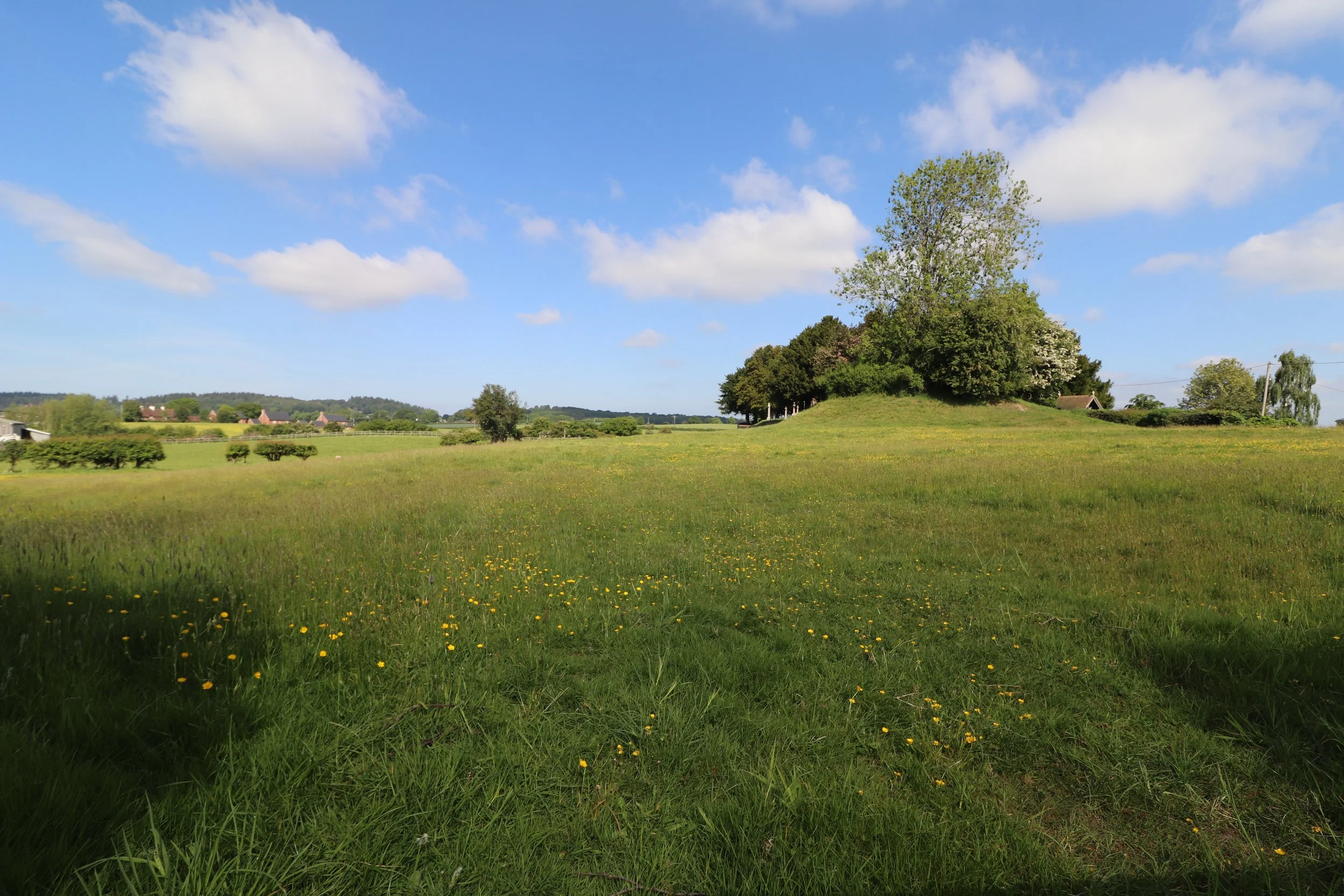
The site itself remains archaeologically intriguing. Knockin Castle has been described both as a timber and a masonry defence, occupying a notably low-lying position. The surviving monument measures approximately 60m by 70m at its base, and 46m by 54m across the top, rising now to a decomposed height of around 4m. The main road, the former A5, built by Thomas Telford in the 19th Century, hugs the Castle’s southern side, while the leat of the Weir Brook skimming the west side of the Castle mound was engineered irrigation system connecting to a water mill which has not been located, although from Guy le Strange granted to Haughmond Abbey, the use of the mill “mill was situated on Morton brook, and that some remains of it can still be traced where the bridge now stands”. Archaeological surveys of the area note that the integrity of original site and it’s surrounding moat has been disturbed.
separate the mound from the adjoining church. Over time, the site has suffered repeated disturbance: invasive landscaping took place within the bailey during the construction of the Rectory in 1901, and as a result it is only the mound itself that remains protected today.
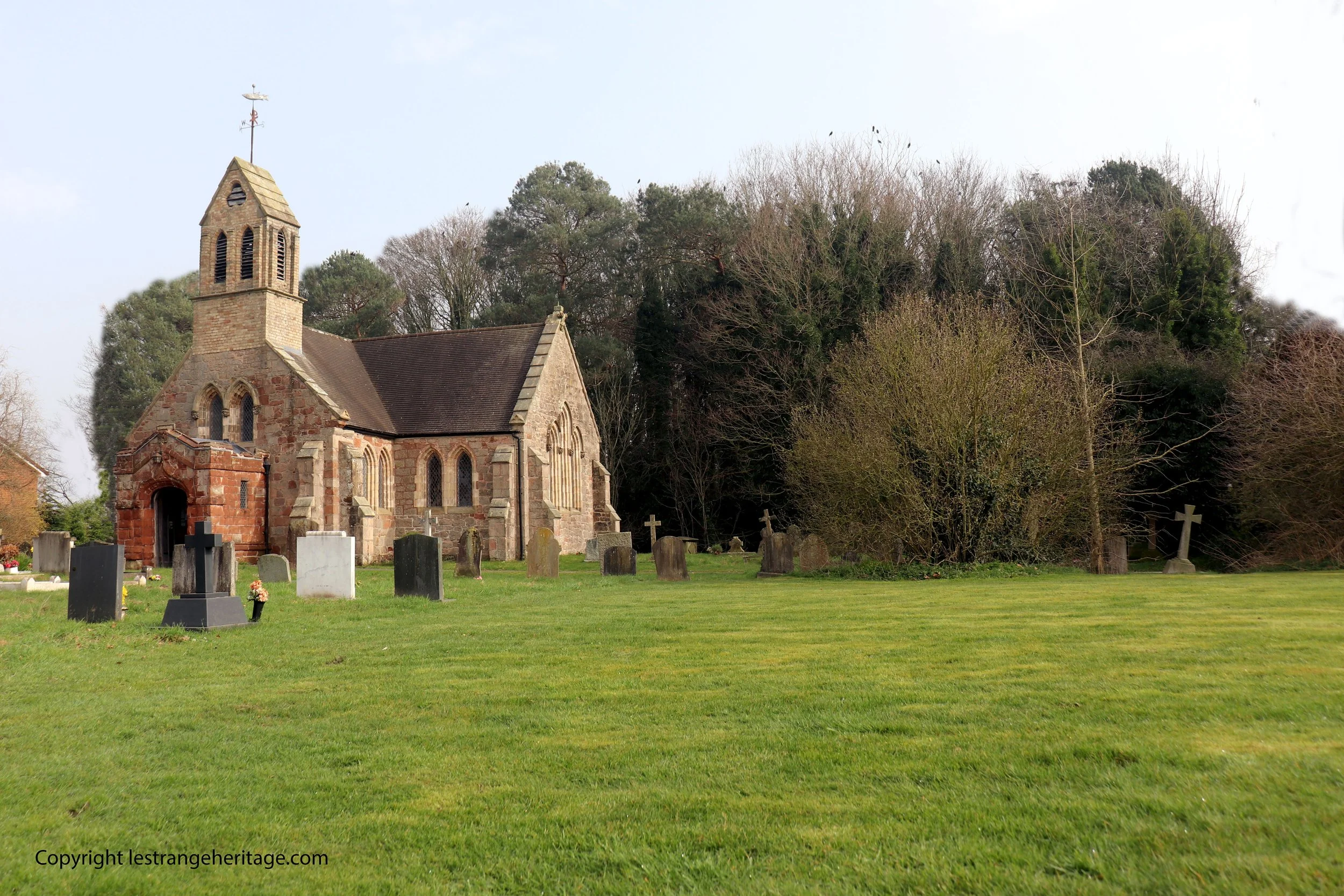
Even so, the site still hints at its former status. Behind the church, the tree-covered monument rises from the landscape, while the impressive red sandstone ramparts can still be discerned by a careful eye, especially in winter when the foliage thins. Publicly, the Church of St Mary appears almost to stand guard over the castle, displaying shifted purpose over time.
Between 1160 and 1179, the manor of Osbaston — later Knockin — grew markedly in prominence. Guy le Strange’s authority as Sheriff was interrupted in 1165, when newlywed Geoffrey de Vere became Sheriff. Could this have been a coincidence given that his new wife’s dowry included many fitz Alan family estates? Whether coincidence or not, Guy disappeared from office for five years, only to be reinstated after Geoffrey’s death in 1170. During his combined 14 years of Office — from 1160 to 1165, and again from 1170 to 1179 — Guy le Strange is accepted as the founder of Knockin Castle.
The family’s connections with the fitz Alans were close. When William fitz Alan died, both Guy and John le Strange were among those at his bedside, illustrating the strength of their long term alliance.
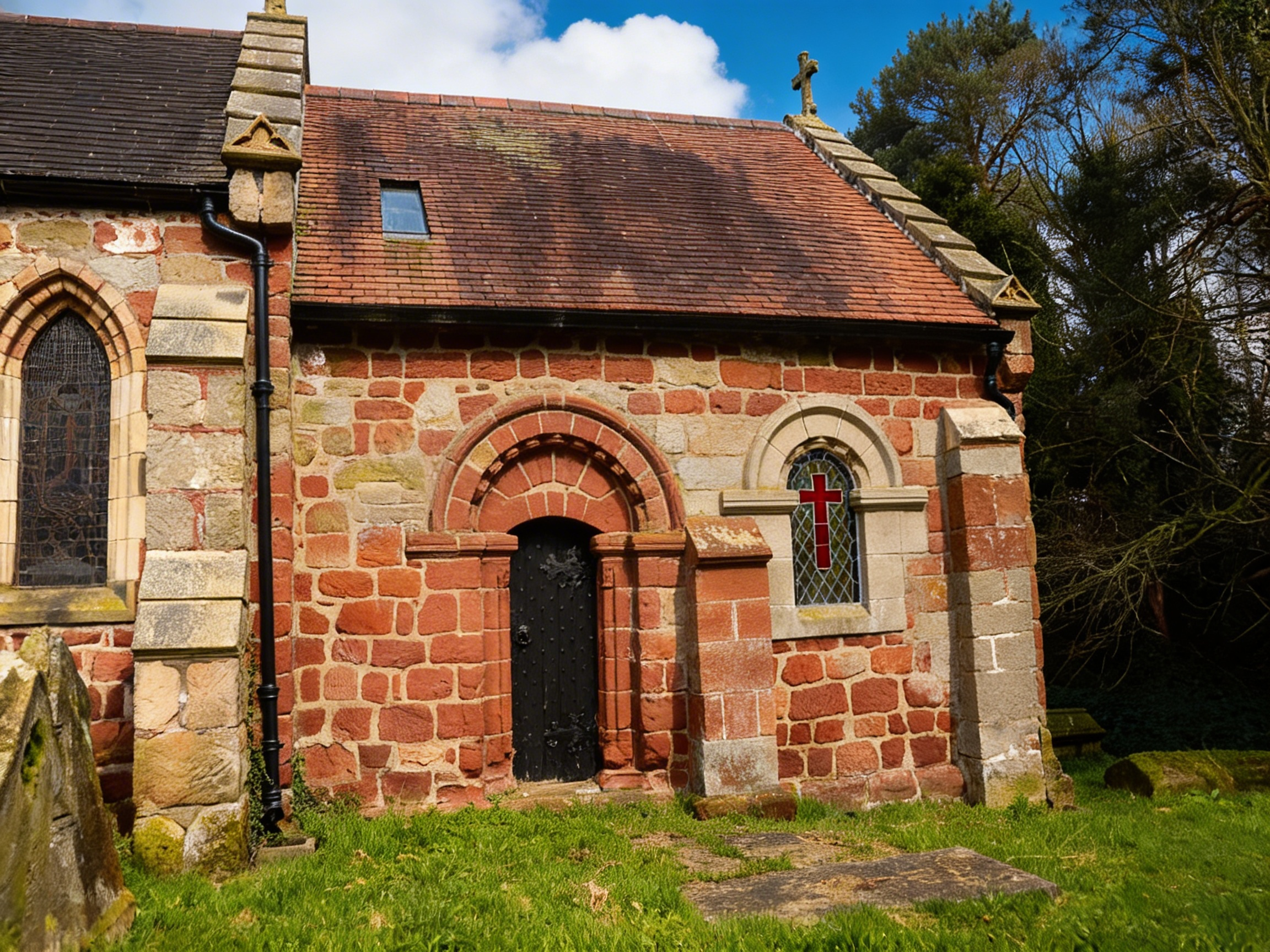
The Church of St Mary was said to be founded by Ralph, son of Guy around 1190-1195. His uncle, John le Strange II, later referred to it ‘new’ church — then more properly a chapel — displays Norman Romanesque architecture, and its dedication to St Mary matches his father’s home church at Old Hunstanton. Perhaps this was no coincidence, but a statement of family identity and continuity.
Contrary to the tradition of Ralph as founder, there is evidence of a mistake with the dating which relies on one William le Strange. More of this later. So if it was indeed founded by a member of the le Strange family, it was more likely to have been Guy.
The family’s religious patronage extended further. Haughmond Abbey ensured that both churches, at Hunstanton and Knockin, were staffed and maintained in return for the grants of farmland the family bestowed upon its monks and nuns. Today, Knockin Church is Grade II* listed, marking it as significantly more important than the average Grade II building.
The succession of Knockin was settled relatively early in its history. John le Strange II of Ness and Cheswardine, following his father’s path, also became Sheriff of Shropshire. In 1198, he succeeded his three co-heiress first cousins, after the inheritance of Knockin had temporarily diverted following Ralph’s death in 1195. Thus, the future of Knockin was resolved amicably within the family, preserving the estate in le Strange hands.
A defining moment came on 16 March 1218, when, at about 40 years of age, John le Strange II received a licence to fortify the manor of Knockin. This formal act legitimised the powerful le Strange seat of Knockin Castle. One cannot help but wonder whether his cousin Ralph of Knockin, who had died 23 years earlier and with whom John had shared a close relationship, would have approved. It seems likely that he would.
From then on, the legacy of Knockin Castle and its Chapel of St Mary passed through many generations of the family. The castle remained a symbol of le Strange authority in the Marches until the 1540s, when John Leland described it as “ruinous.” How exactly Knockin fell into ruin remains unknown.
By that time, the world around it had changed dramatically. Haughmond Abbey, where members of the family were likely buried, had itself been demolished during the Dissolution of the Monasteries under Henry VIII. Sir Thomas le Strange of Hunstanton, then a courtier and Esquire of the King, together with his younger Stanley cousin, the 11th Lord Strange of Knockin, lived through those upheavals. They would have witnessed not only the destruction of the abbey, but very likely the loss of treasured family monuments and tombs.
Yet the le Stranges remained in royal favour. Ralph le Strange, having founded Knockin Church, had also founded the Hospital of the Holy Trinity at Bridgnorth, near the River Severn bridge. The hospital offered relief to pedestrian travellers who could not afford to journey on horseback, providing shelter and assistance to those most in need. Each year, on the anniversary of its foundation, the abbot distributed 80 pence among the poor as an act of charity. Records from 1535 confirm that these annual commemorations had already been observed for over three centuries, recognised during the reign of Henry VIII. Even amid the violence and destruction of the Tudor age, the family’s legacy endured.
Knockin itself had long represented more than a manor or a castle. In 1381 Lord Roger le Strange of Knockin, Steward to Richard, Earl of Arundel died, leaving manors ie. Ness and Ellesmere, and the Castle of Knockin and it’s Demesne (Estate) to his son. It was the furthest outpost in the Marches, and it was the Family’s role in defending and defining the borders between England and Wales. The Castle monument is a reminder of the le Stranges’ determination to hold the boundary with their Motto: Mihi Parta Tuerri (I will defend what is mine), and of the remarkable medieval legacy they left behind, with the boundary being invariably unchanged.
The Barony merged with the Stanley, Earls of Derby and the Family never died out.
-
This Fief was held by the le Stranges under the Fitz Alan Family becoming a long term Family residence. It was held before 1172 by John le Strange I (d.1178).
On 21st June 1234, a peace treaty was instigated and concluded at, or near, Myddle Castle, then held by John le Strange III of Knockin. The agreement was made between Henry III of England and the Welsh prince Llywelyn the Great.
The treaty followed a period of conflict in which John le Strange’s father had died at Shrewsbury, after the town was set ablaze during Llywelyn’s campaign in the region.
The building stands on private land and survives today as a ruin. It is associated with the outlaw Humphrey Kynaston, who is said to have allowed it to fall into decay through mismanagement. He acquired the castle by marriage, through a connection with the le Strange family, who had held it for approximately 400 years. Above the remains of a spiral staircase, the le Strange coat of arms.
Myddle Castle is now a ruin. It was built around 1307 for Lord le Strange of Knockin. The castle was made mainly of red sandstone and once stood within a rectangular moat.
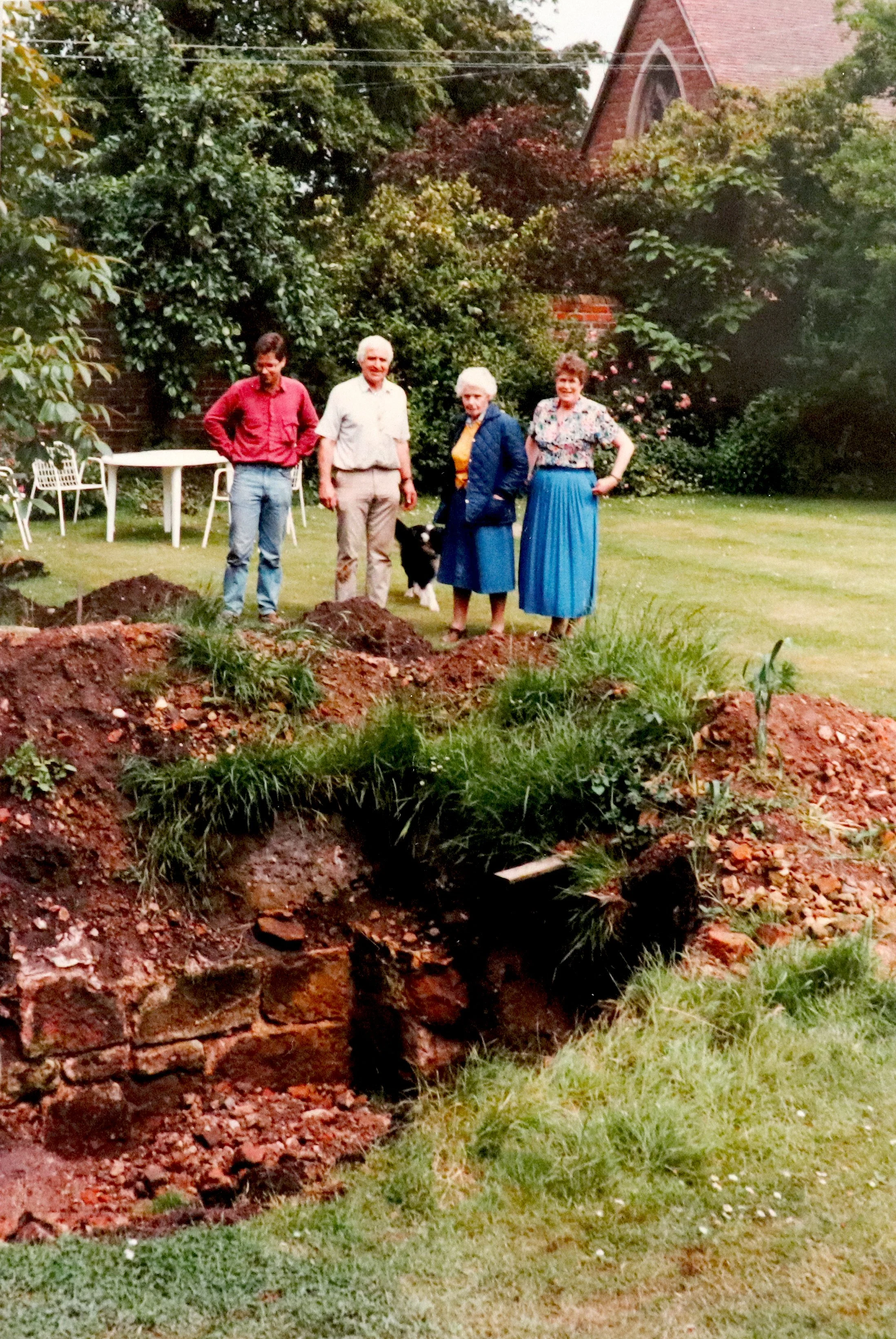
Today, only part of the north-east corner survives. This includes the remains of a corner stair turret and sections of the inner wall that once supported the moat. A small window can still be seen in the northern wall, and part of a larger window in the eastern wall suggests there may once have been a hall on the upper floor.
A decorated doorway leads into the remains of the stair turret, where the first steps of a stone spiral staircase still survive.
An inscribed stone records repairs carried out in October 1849 by John Humfrey Egerton, Viscount Alford, and his steward. Nearby, a carved stone shield has also been found.
Parts of the moat wall still remain, forming sections along the eastern and southern sides of the castle. Some pieces of carved stone from the original buildings are built into these walls.
The castle was licensed to be fortified in 1307.
-
This Fief was held by the le Stranges under the Fitz Alan Family over generations. Little Ness, near Great Ness (see below), encompasses the site of an early medieval motte-and-bailey castle together with a church. The motte would most likely have supported a timber structure rather than a stone keep. The church—St Martin’s—began as a small chapel dating from the same period as the castle, and remains standing, together with some of the orginial Norman details.
It is therefore notable that the medieval portion of the church would have served as the le Strange family’s private chapel within the grounds of their residence, a customary arrangement for a manorial site of that era.
Church of St. Martin: Historic England Scheduled Monument
Castle Motte: Historic England Scheduled Monument
Gatehouse Website (Philip Davis) Little Ness Castle Mound
-
Ness Strange Manor House, located at Great Ness near Shrewsbury, is said to have been built in the 18th century by a relative of the le Strange family upon the foundations of an earlier medieval manor that had belonged to the le Strange family, firstly, John le Strange I.
From this continuity of ownership and association, the house acquired the name “Ness Strange” Manor House. Today, the 18th-century building has been divided into individual flats, operating in a similar manner to a house in multiple occupation.
A comparable fate befell the ancestral residence, Hunstanton Hall, which after its sale was first divided into three residences in the early 1950s and is now arranged into four separate divisions.
-
This Fief was granted to John le Strange I abt. 1140. The original castle at Ruyton was likely a timber-built structure erected between 1086 and 1148, possibly by John. Possibly by 1313 the location had been refortified with a stone castle after being destroyed by Welsh forces in the early 13th century. It may still have been in ruins in 1302 when the le Strange Family sold it to the Earl of Arundel.
In 1172 John le Strange I held Ruyton. There is no evidence that the le Strange family, who held the manor of Ruyton throughout the 13th century, ever rebuilt the stone castle. Shortly after succeeding to the title in 1301, however, Edmund, Earl of Arundel, purchased the manor from the le Stranges, his feudal tenants. If the castle was in ruins at that time, he must have restored it, as evidence shows it was standing again by 1313.
John le Strange appears to have established a deer park at Ruyton. Around 1195, he reached an agreement with the abbot of Shrewsbury to incorporate a corner of the abbot’s wood at Birch, described as stretching “from the place where the le Strange Park fence came down to the water of Peverec, to the end of his meadow on the side of Plettebrug mill.” In return, he agreed to pay the abbot an annual rent of one doe. A few years later, he granted Ruyton mill to Haughmond Abbey, disregarding an earlier grant of the same mill made by his father.
In 1269 John le Strange IV held Ruyton Manor, and in 1302, his son, John le Strange V, sold the manor of Ruyton, together with all its homages and feudal rights, to his overlord, Edmund, Earl of Arundel. Included in the transaction was the outlying manor of Glazeley, which formed an appurtenance of Ruyton.
-
The Fief of Cheswardine Castle was given to Hamon le Strange by Henry II in 1155. This followed the initial Wellington fief in 1148 under King Stephen. Hamon was the son of Matilda and Roland le Strange of Hunstanton. In 1376 the manor passed from the le Strange family to Richard, Earl of Arundel and Surrey.
-
In 1263, Ellesmere Castle was granted to Hamo le Strange, Crusader - married to the Queen of Cyprus, after which it went to his younger brother, Roger of Ellesmere, eventually passing to the Stanley family, the Earls of Derby who were united in marriage with the le Strange family. However, it is not known when the castle was abandoned or whether Baroness Strange had use of it.