Ralph of Hunstanton: A Domesday Mystery Hidden in the Scribes' Hands
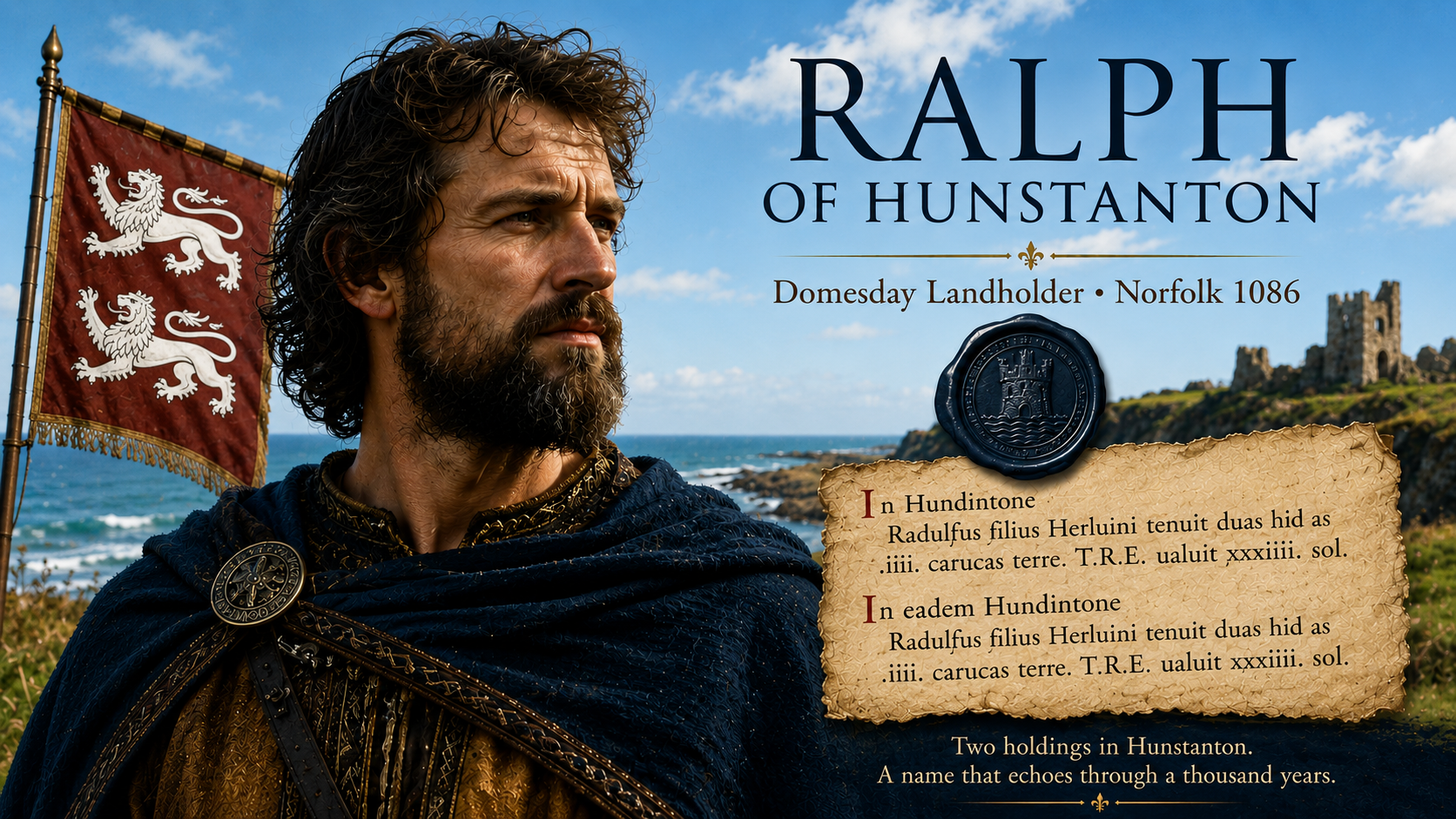
Depiction of Ralph fitz Herluin in 1086, Ancestor or the Le Strange Family.
For some time, I have been researching the Domesday entries associated with the ancestor of the Le Stranges; Ralph of Hunstanton, also recorded as Ralph son of Herluin. My starting point of reference has been the Le Strange Records, written by my maternal great-great-grandfather, Hamon le Strange of Hunstanton Hall. As I began comparing his work with the original Domesday entries, an intriguing pattern emerged. What follows is my account of that investigation — and the possibility that Ralph’s Domesday landholdings may have been considerably more extensive than previously recognised.
“Ralph de Hunstanton … is undoubtedly the same as Ralph fitz Herluin.” [The Le Strange Records]
Further, I had been trying to reconstruct the lands of Ralph fitz Herluin, my ancestor, from Domesday Book, if only to find the human side of him.
On the face of it, it seemed fairly straightforward. Ralph is currently credited with nine places in Norfolk. At Massingham, Domesday actually gives me his father as well: Radulfus filius Herluini — Ralph, son of Herluin.
Then I found him again at Stanford. Radulfus.
So far, so good.
But then, while working through the lands of Reginald fitz Ivo, I kept coming across another man.
Ranulf.
He appeared at Haveringland. Then Beechamwell. Pensthorpe. Shouldham Thorpe. Stiffkey. Upwell. West Winch. Fodderstone.
Eight places.
Initially, I assumed what everybody else had assumed: this must be another man.
Ralph was Radulfus. This man was Ranulf.
But then I started looking at the actual handwriting in Domesday Book, rather than the modern transcriptions.
And that's when I stopped.
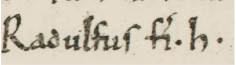
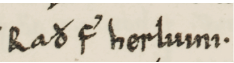
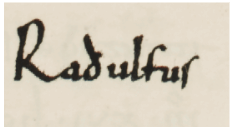
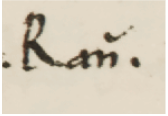
The handwritten spellings were different.
The hand recording Ralph at Massingham and Stanford was not simply giving me another spelling from the same-looking piece of text. I was looking at material written in a different hand from the entries in which the other form of the name appeared.
And suddenly I had a problem.
To add context, Medieval names weren't fixed in the way ours are today. A man's name could be heard differently, Latinised differently and written differently because there was no such thing as a Dictionary in the 12th century. Differing forms such as Radulfus, Randulfus and Ranulfus could overlap in medieval records.
So what if I wasn't looking at two men at all?
What if I was looking at two or more scribes writing the same man's name differently?
Then I looked at where these men actually were.
And that made the coincidence harder to ignore.
Ralph fitz Herluin was a tenant with Reginald fitz Ivo assigned as his overlord.
The variants of the ‘Ralph’ spellings may not have been two similarly named men appearing in unrelated parts of England. We are talking about the fact that the name appears to be operating inside the same Norfolk feudal network, under the same overlord, at the same time.
And then came Haveringland.
At Haveringland, alongside the man written as Ranulf, was Herluin fitz Ivo himself — the very man I was investigating as the possible father of Ralph fitz Herluin.
That was the moment the spelling stopped being enough for me.
I could no longer comfortably say, “Radulfus here, Ranulf there — therefore two different men.”
The land was telling me something more complicated.
The handwriting changes. The spelling changes. But the family and feudal network stays remarkably close.
None of this proves that Ralph and Ranulf were the same person. That distinction is important.
But it does mean that before we create a second man called Ranulf, we have to ask whether that second man really existed — or whether two different scribal traditions have divided an eleventh-century landholder into two people for us nearly a thousand years later.
And if they were the same man, it changes the picture considerably.
Ralph fitz Herluin may not have been the holder of only the nine Norfolk places normally attributed to him in the Le Strange Records.
Some of those eight “Ranulf” estates may have been his as well.
And there was Titchwell, a good example of how Domesday records the tenant simply as Ralph — right beside his known lands at Hunstanton and Ringstead, and a place that would later appear as an inheritance in the history of the le Strange family.
I had started with nine places and a man called Ralph.
I was beginning to wonder whether Domesday had preserved a much larger estate — but scattered its owner across different spellings and different hands rather than attributing the hand writing to various local scribes.
How much land might Ralph of Hunstanton actually have held?
In summary, the conventional reconstruction from the Le Strange Records attributes nine to ten Norfolk places which likely included Titchwell as well, to Ralph fitz Herluin. However, my examination of the Domesday entries raises the possibility that his estate may have been considerably larger.
Alongside those nine recognised holdings is a second group of eight places attributed in modern indexes to Ranulf. As mentioned, the handwriting differs from the entries naming Ralph, suggesting that we may be looking at material produced by different scribes or derived from different written returns.
For accuracy this is an important consideration. Medieval names and their spellings were not standardised, and forms such as Radulfus/Ralph and Ranulfus/Ranulf could sometimes be used for the same individual. With no fixed spelling conventions or dictionaries, a name might be written according to how a particular scribe heard, pronounced and Latinised it, influenced by his own accent and linguistic background. So it became a more personal entry to the scribe on duty. Consequently, a difference in spelling does not necessarily indicate a different Lord, but highlights the element of human-ness of the individual scribes and land holders involved in the survey whose medieval accent could easily be removed from the equation.
Further, more importantly, these eight holdings are not randomly scattered. They repeatedly occur within Reginald fitz Ivo's Norfolk fee — the same network in which Ralph fitz Herluin appears.
At Haveringland, the man written as Ranulf even occurs alongside Herlewin fitz Ivo, Ralph's possible father.
Bear in mind Domesday survey was undertaken 20 years after the Norman Conquest, allowing potential for two living adult generations of Lords within the Family.
RALPH OF TITCHWELL
The Titchwell holding:
Domesday records:
Roger Bigot → Ralph → Titchwell
but gives this Ralph no patronymic at all. As mentioned, Titchwell lies immediately within Ralph fitz Herluin's north-west Norfolk territory, close to his known holdings at Hunstanton and Ringstead.
And the important clue: Titchwell subsequently belonged to the le Strange family, descendants of Ralph's heiress Matilda. This does not by itself prove that the Domesday Ralph of Titchwell was Ralph fitz Herluin, since the le Stranges could have acquired the property later, but the continuity makes this unidentified Ralph particularly interesting, not least as Roger Bigot was ancestor of the Arundel Earls subsequently linked with the le Stranges.
This gives a working possibility of as many as 18 Norfolk places:
The 9 presently attributed to Ralph fitz Herluin
Hunstanton
Ringstead
Great/Little Massingham
Bexwell
Downham Market
Snetterton
Stanford
Sturston
Tottington
The 8 Ranulf holdings under investigation
10. Haveringland
11. Beechamwell
12. Pensthorpe
13. Shouldham Thorpe
14. Stiffkey
15. Upwell
16. West Winch
17. Fodderstone
The unidentified Ralph
18. Titchwell — held in 1086 by an otherwise unidentified Ralph under Roger Bigot and subsequently found among the le Strange family's Norfolk interests.
This may not be wholly a coincidence. So the possibility is that Ralph fitz Herluin may have held as many as eighteen Norfolk places, rather than the nine conventionally attributed to him. It remains a hypothesis, but the scribal variation, the Reginald fitz Ivo connection, and the later le Strange association with Titchwell give us several independent reasons to test it.