Le Strange Family Burial Locations
Burial Locations
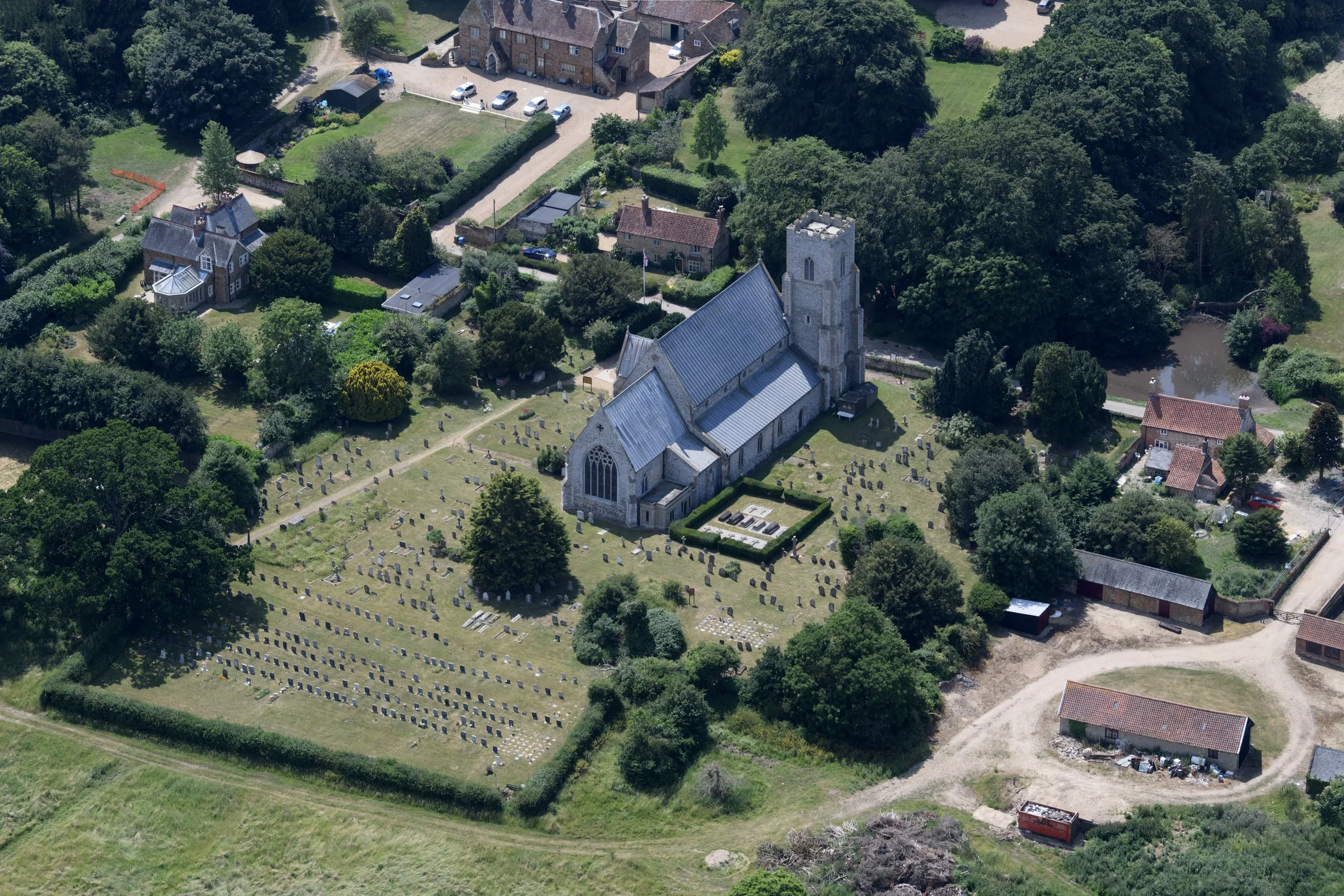
Church of St. Mary The Virgin, Hunstanton, Norfolk
A collection of le Strange Family Tombs and Monuments exist at the Church of St. Mary The Virgin, Old Hunstanton, dating back to 14th Century. The Family records date back to 1086 and so it is evident that some of the burials remain unknown. The early Family Knights were obliged to relocate their duties to the Frontline Marches of Shropshire at the beginning of Henry II’s reign. This was a time of expansion for the le Strange Family, when links between this Church and Haughmond Abbey in Shropshire, were established.
Already in 1086 during the Reign of William The Conqueror there was a “church without land” on the land of John (Nephew of Waleran fitz Ralph). This reference indicates that the Church was reliant on this man and his family perhaps as a small un-consecrated manorial chapel ie. without burials.
This reference also indicates that the le Strange Family ancestor Ralph fitz Herluin was John fitz Ralph’s neighbouring land holder at the time. Each held land at Hunstanton in 1086 independently of one another, and it was ‘Ralph fitz Herluin who owned the most valuable portion out of the 3 other landholders - other than King William himself.
It is the direct descendants of Ralph fitz Herluin who continue the legacy and historical connection with the Church today. The le Strange Family name was established through Ralph’s son in law, Roland le Strange.
Early relics belonging to the old Church of St. Mary, include an unnamed stone coffin lid believed to be of 11th-12th Century origin. Today, the Church sits within the le Strange Estate and it is possibly that the Coffin belonged to a prominent supporter of the Church from the time of Domesday or after.
Two other early surviving remnants of his day are the piscina, and the Norman font, which will have witnessed many Family gatherings upto modern day.
The Victorian, Henry Styleman le Strange, had outlined ambitions to build a family burial vault, however, due to his early demise remained unfulfilled.
It was in 1172, when the son of Roland, John le Strange [I] - who was a Canon - gave the patronage of the Church of St. Mary at Hunstanton to Haughmond Abbey, making the Abbey responsible for it. When the King came to Shrewsbury, he formally approved this in a Charter of 1176. With the church at Old Hunstanton being placed under the control of Haughmond Abbey it would be well supported during that era.
Also in 1172, the years preceding John’s death, he had actively granted 3 other lands to the Abbey. A final one was made in 1177, about a year before he passed away at the close of 1178 or early 1179. The Abbey precedence meant that John’s gifts would automatically have earnt him the right to be buried at there, which he, himself would have been mindful of this.
The Abbey began as a small Chapel and was founded by William fitz Alan circa 1120-1130, and John le Strange [I] had witnessed his friend, William’s grant to it before 1138 when the Abbey was being established. John le Strange’s promoted status was gained under King Henry II in the 1150’s, and although the full original burial roll of Haughmond Abbey has not survived monastic precedent made Family interments at Haughmond Abbey very likely.
Suffice to say that a few unnamed tombs exist among the ruins today, the destruction being caused by the dissolution of Monasteries under King Henry VIII.
As major Patrons and Benefactors of Haughmond Abbey their burial rights were earnt. While aiding the expansion of Haughmond Abbey there was a far greater one in the Town itself. Shrewsbury Abbey proved to be one of the most prestigious burial choices for the highest ranks of Nobility, making Haughmond Abbey an ideal choice for domestic Families such as the le Stranges.
Hunstanton Missing Tombs
Regarding unnamed tomb there is also one belonging to the Church of St. Mary The Virgin. This has been dated back to 11th-12th Centuries. It is here that the younger branch of the 14th Century le Strange Family began some important re-building projects. Not least, between the years 1506 to 1643 is gap of 137 years of missing burials. Perhaps to account for this, the gap covers two important historical events, when Protestantism took over from Catholic faith under Henry VIII. Burial style was kept simple, and while grave destruction was also a issue, destruction filtered through into the 1640’s English Civil War. Further major floor renovations during the 19th Century mean that one can only guess why 3 generations of monuments at Hunstanton lack visibility.
As major Patrons and Benefactors of Haughmond Abbey the Family’s burial rights were in place while supporting its expansion, while in the Town itself was a far greater Abbey fit for than Haughmond, also proving to be the most prestigious burial site. This means that Haughmond Abbey was the ideal site for domestic Families.